Traditional IVR, Visual IVR, Digital ARS, Voice AI — Four Systems With Different Branch Logic
Sorting visual IVR and voice AI by screen presence misses the most important difference. What matters is whether branch conditions live in a config file or emerge from the conversation.

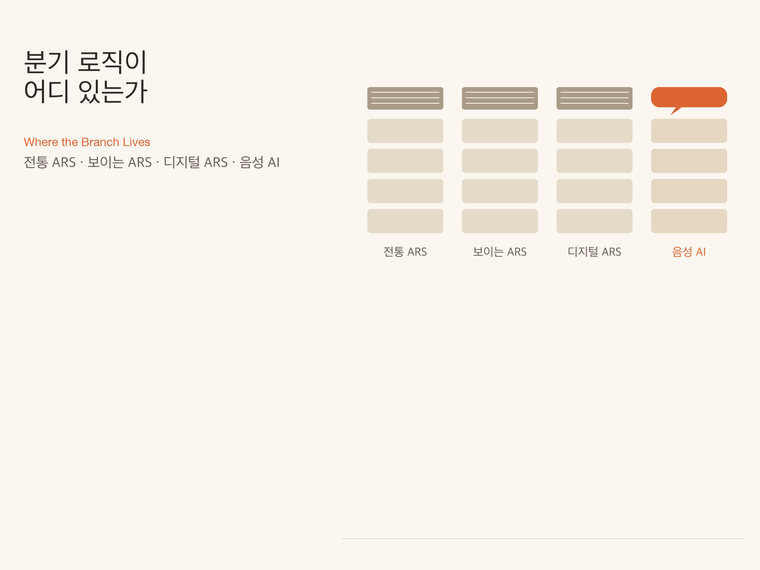
Traditional IVR, visual IVR, digital ARS, voice AI. By name, the first three read as one family and the last as an outlier. Sort them by where the branch logic sits and the boundary lands elsewhere.
Traditional IVR keeps its branches in a config file
"Press 1 for support, press 2 for reservations." A keypress sends a DTMF tone; the server reads it and moves to the next node. Which tone leads where is written into a server config file.
Changing one path means opening that file. An intent no number stands for has nowhere to arrive.
Visual IVR changes the screen, not the branches
Buttons appear on the caller's smartphone. Tapping one sends an input in place of a DTMF tone. That is the whole of what changed.
The menu can run longer, options can carry text and images, and miskeys drop off. But a path the designer never wrote down still does not exist. The branch conditions sit in the same file as before.
Digital ARS finishes branching before the call connects
The destination is set by the time the caller hits dial. Pick "service request" in a mobile app, connect, and the call lands on that team. No greeting, no menu.
Routing is computed on the app screen; the call is the last step that executes it.
Voice AI builds branches out of what gets said
"I want to file a service request — it's a follow-up on last month's job." The agent reads intent and context together, then settles on a handling path. No numbered menu, nothing to memorize.
Something new does have to be designed, though. When the agent misreads intent or branches on low confidence, no config file catches it. Skip that and callers slide quietly onto the wrong path.
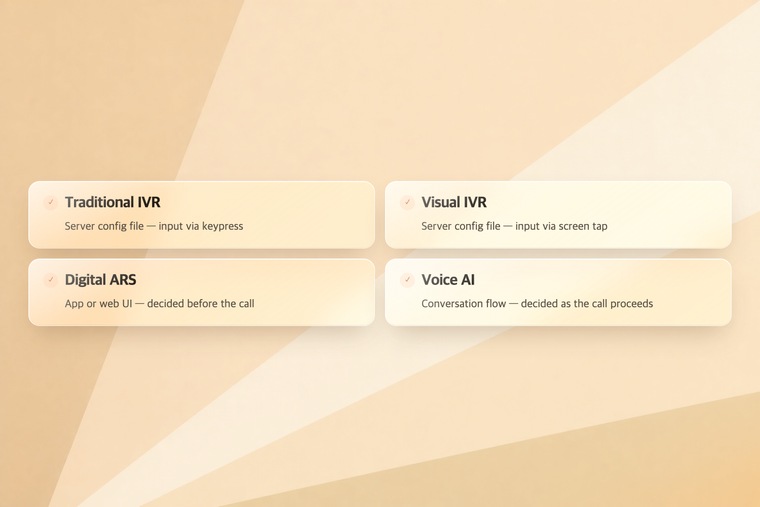
Sorting by screen presence hides what matters
Apply the "screen means digital" test and visual IVR lands in the same bucket as voice AI. This is where diagnosis stalls. Visual IVR changed the input method; voice AI changed when the branch condition gets formed. Only voice AI forms that condition inside the call.
"We run visual IVR, so we're already modernized" comes out of that bucket, and from there it is hard to see which part of the flow to fix.
Where this framing breaks down
The sort holds while each system runs as a single block. Real contact centers are mixed. Front the queue with visual IVR, hand off to voice AI mid-call, and branching happens in two places. The question becomes which segment's branching to fix.
On what carries over in that move: What to Keep When Moving from IVR to Voice AI.
Before pricing a replacement, measure whose time it takes, and how much of it, to change a single branch in the system you run today. That is the comparison baseline.