What to Keep When You Replace an IVR With AI
Press 0 for an agent, call back past a 30-second wait. The document that set those rules was issued in 2009. The menu tree can go; the four promises behind it cannot.

Press 0 for an agent, # to go back. The document that fixed that layout was issued in November 2009, and most Korean IVR systems still follow it.
Replacing one with a voice agent starts by deleting that table. Some lines can go; some cannot.
1. We Are Still Calling on 2009 Rules
The Korea Communications Commission issued its ARS Service Operation Improvement Guideline on 25 November 2009, a voluntary-compliance recommendation. What it wrote down is what the caller is guaranteed, and new equipment does not change that.
Agent connection    press 0
Previous step       press #
Repeat              press *
Menu depth          3 levels recommended, never more than 5
Agent wait          over 30 seconds, offer a call-back
Charges             disclosed in the opening prompt and on the website
Service map         publish the ARS TREE on the site and in guides
Source: KCC guideline, 25 November 2009 (voluntary compliance).
2. Two Fewer Questions Bought 16 Seconds
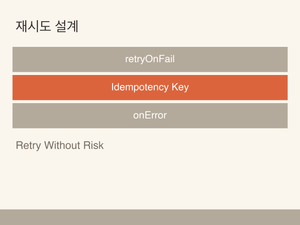
Rebuilding its IVR in August 2009, Korea's Health Insurance Review and Assessment Service dropped the individual-versus-institution split and the code entry after it. Four steps became two, and time to an agent fell from 41 seconds to 25.
The agency published those figures itself (Dailypharm, 3 August 2009) — not independently verified, and from 2009.
Nothing about the equipment produced those 16 seconds. Two questions did.
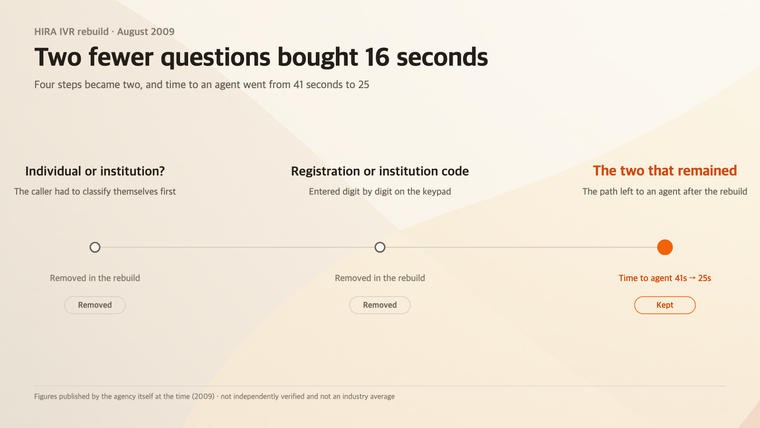
Path length and technology are different jobs. The 41 and 25 second figures are agency-published, 2009 — not an industry average.
3. What Actually Disappears
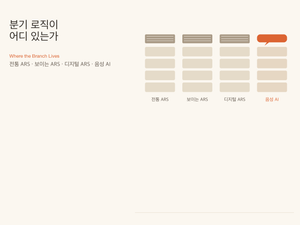
One thing goes: the menu tree — translating your problem into someone else's org chart.
- The caller decides which department owns the question
- A wrong guess sends them back to the start
- A reorg voids any memorised route
A voice agent takes the request as spoken and sorts it afterwards. No levels to count.
4. The Four Lines That Must Survive
What carries over is the promise behind the layout.
- A human is always one request away. Spoken now rather than pressed, handed off at any point
- Waiting has a ceiling. Past 30 seconds, call the person back — a voice agent does that well
- Scope is stated up front. A voice agent accepts any sentence, so a scope surprise mid-call is worse than a tree
- Costs are disclosed in advance. Call charges, plus recording and AI-processing notice
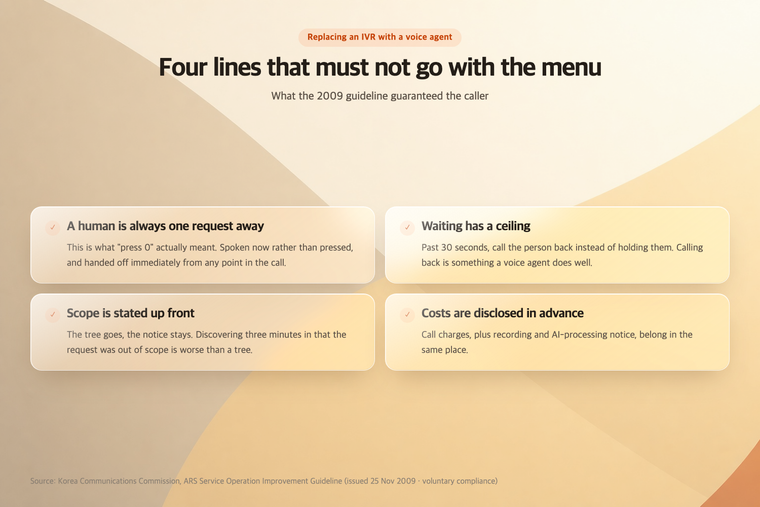
They read like a feature list. They are promises already made to callers.
BringTalk asks for the existing tree first — to find where these four sat inside it.
5. When This Does Not Apply
Two situations are better off with the number tree.
- Three or four fixed options that never change. For delivery tracking, one keypress beats a sentence
- Calls from noisy places. Speech recognition wobbles on a factory floor; a keypress does not
The four lines still apply in both.
6. What to Take Away
An IVR replacement deletes menus, and fails when the promises go too. Show where the four live in the new flow and the switch lands.
Send us your ARS tree and we will check it against the four.
Baseline: KCC guideline, 25 November 2009 — agent access, a 30-second callback ceiling, a five-level cap. HIRA: four steps to two, 41 seconds to 25 (agency-published, 2009). Depth was cut; the promise kept.