What Telemarketing Actually Means — What AI Changed and What It Didn't
Telemarketing is defined by purpose, not by who dials. When AI places the call, prior consent, disclosure, and opt-out handling still apply exactly the same way.


Say "telemarketing" and most people still picture a script-reader on the other end of the line. But Korea's Door-to-Door Sales Act never defined this activity by who dials — it defined it by whether the call is soliciting a commercial transaction. An AI agent delivering the first line doesn't erase that legal definition, and the bigger the calling volume gets, the more it matters to know it precisely.
The definition is about purpose, not the dialing method
Article 2, Item 3 of the Door-to-Door Sales Act defines "telephone solicitation sales" as selling goods or services by using a phone call to solicit a consumer or induce a callback. Nothing in that definition distinguishes a human agent from an automated system. Whether a rep or a scheduler pressed dial, whether the opening line was spoken or synthesized, the statute does not ask.
Telemarketing is defined by intent, not channel. When an AI places the call instead of a person, the commercial-solicitation purpose stays exactly the same.
Telemarketing and outbound automation are not the same word
Two concepts get conflated constantly in practice.
- Telemarketing: outbound calls whose purpose is to solicit a purchase of goods or services. Prior consent and opt-out handling apply in full.
- Outbound automation: the automated calling channel itself. Booking reminders, no-show confirmations, delivery updates, and satisfaction surveys all run on this channel without being a commercial solicitation.
A reminder call is outbound automation, not telemarketing. Conversely, a human rep pitching a product by hand is telemarketing. Collapsing the two into "any automated outbound call is telemarketing" produces mistakes in both directions — non-regulated calls get needlessly tangled in consent workflows, or regulated calls get waved through as informational.
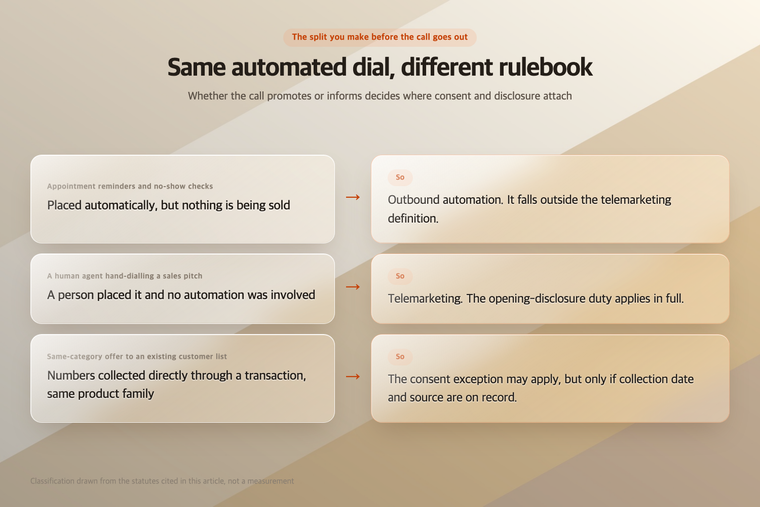
The solicitation decides the rulebook, not the dialing. Drawn from the statutes cited above, not a measurement.
What hasn't changed — disclosure at the moment the call starts
Article 6 of the Door-to-Door Sales Act requires a telephone solicitor to disclose three things at the very start of the call: that the call is for sales solicitation, the seller's name, and the type and content of the goods or services being offered. That obligation applies exactly the same way when an AI voice agent places the call. A design that eases into the conversation before stating its purpose can delay a disclosure the law requires upfront.
The practical trap — treating "existing customer" as a blanket exception
Article 50 of the Network Act carves out one exception to prior consent: contacts collected directly through an existing transaction relationship, contacted about the same category of goods or services, within a period set by presidential decree. The trap is stretching that exception in practice to "they're an existing customer, so anything goes." A call outside the matching product category, past the eligible period, or to a contact never obtained through an actual transaction falls outside the exception entirely. And even inside the exception, the moment a recipient signals refusal, no further call is allowed. Treating "existing customer" as a blanket substitute for consent is the trap that surfaces first once calling volume scales.
What AI actually changes isn't scale — it's real-time branching
Before AI, the bottleneck in outbound telemarketing was headcount. Volume alone was never the constraint — a dialer could already push that up. What AI moves is the bottleneck itself: how a call responds in real time to whatever objection comes up, and how reliably it catches a refusal the instant it's spoken.
Call initiated
 └ Disclose purpose, identity, product type (Art. 6)
     └ Confirm prior consent OR Network Act Art. 50 exception conditions
         └ Conditions not met → block the call
         └ Conditions met → proceed with solicitation
             ├ Interest shown → route to agent or next step
             ├ Refusal detected → remove from call list immediately, end call
             └ Undecided → confirm callback consent, end call
The value AI adds isn't the third line — it's the two branches beneath it.
Machines catch opt-outs more consistently than people do
A human agent under call-volume pressure can miss a "please stop calling" or hand off the follow-through to the next shift. Shift changes, fatigue, and daily call counts all make the same refusal phrase get processed at different speeds. A voice agent, once the refusal-intent patterns are defined, repeats the identical procedure — immediate removal from the call list — without exception. This is one of the few compliance areas where AI genuinely outperforms people: it isn't emotional labor, it's deterministic execution.
Where people still have to stay in the loop
Legal liability and dispute handling don't automate. When a complaint says an opt-out wasn't honored in time, someone still has to pull the log and judge responsibility. The Door-to-Door Sales Act also sets out a separate withdrawal-of-offer procedure — a window after contract signing during which the consumer can cancel — and that step is usually designed to require a human agent's confirmation. AI can handle solicitation and disclosure; contract execution and withdrawal are left to people.
The order to check before you dial
Turning the above into a build sequence:
- Classify whether this call is a commercial solicitation, or a non-solicitation call like a booking reminder.
- If it's a solicitation, confirm prior consent — or, absent that, confirm the call fits the Network Act Article 50 exception exactly (relationship, product category, time window).
- Put the three Article 6 disclosures — purpose, identity, product type — in that order at the start of the call.
- The moment refusal is detected, remove the contact from the call list immediately, and log the action so a person can review it later.
Skip any one of these four steps, and scaling up AI calling just scales up your compliance violations alongside it.
Where telemarketing outreach lands isn't the same desk it left from. The outbound call follows telemarketing rules; the inbound inquiries it generates are a design question for AICC — the assembly that ties the whole contact-center system together. Consent and refusal rules on the outbound side, and agent-routing structure on the inbound side, need to be designed separately. However sophisticated the outbound agent gets, if there's no inbound structure to receive what it generates, the call you just placed becomes the new bottleneck.
The line that matters: whether something counts as telemarketing depends on what's being solicited, not who dials. Get that call right first, and disclosure, consent, and opt-out handling all know where they belong.