Where to Stop When You Automate a Recruitment Screening Call
What a first call can hand over is confirmation, not filtering. And a script asks every question a recruiter used to skip.


When applications pile up against one posting, the first screening call is what slips. That is where automation comes up, and where it goes wrong the moment it becomes "let the agent filter candidates." Automation ends in front of the filtering.
Confirmation Is as Far as It Goes
Automating the first call brings evaluation to mind. The part that moves safely sits earlier — checking whether the conditions already written in the posting hold for this candidate.
The two differ in what a mistake costs. A confirmation that goes wrong can be asked again. An evaluation, once it files someone as "not a fit," leaves almost no route back. Mix the two into one call and you also lose track of which side failed. For the candidate the call is simply over, with nobody left to ask. What scopes the automation is the cost of undoing it, not how long the call runs.
Three Clusters You Can Hand Over
Location, work arrangement, earliest start date, already printed in the posting and matched against the person. Draw the line and most of what detaches from a first call falls into three clusters, and this is one of them. When the answer lives outside the posting, a human takes it from there.
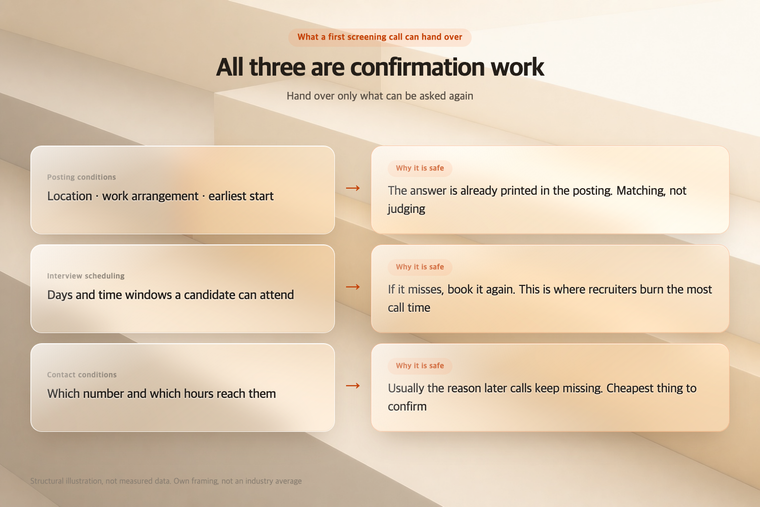
All three are confirmation work, so a mistake can be undone.
Interview scheduling moves across too — the days and windows a candidate can attend, where recruiters burn the most call time.
Which number and which hours actually reach someone gets confirmed here as well. Contact conditions look trivial, so they get skipped, and they are usually why later calls keep missing. Confirming them costs less than the other two.
Where People Take Over
- Personal information unrelated to the job. Korea's Fair Hiring Procedure Act bars employers from asking for information not needed to perform the job. People skip those questions by instinct. A script does not.
- Pass or fail notifications. If an automated call delivers the outcome first, nothing is left to correct it with. Keep that on a separate path.
- Offer negotiation. Once figures are exchanged, it stops being confirmation and becomes a commitment.
Where This Most Often Goes Wrong
A script asks everything. That is the strength and the trap.
Lift the human call straight from a transcript into a prompt and every question a recruiter used to skip comes back. That a line about marital status still sat in the company script is something most teams find only after automating it. Delete sentence by sentence first — summarizing the transcript hides this rather than exposing it.
These are outbound calls, so one more precondition applies, written up separately in preconditions for outbound voice AI.
When This Does Not Apply
There are places where the distinction buys nothing. With small hiring volume — a dozen applicants per posting — working the list directly is faster. When a posting states no conditions at all, there is nothing to confirm against, so fix the posting first. And with experienced hires, conditions vary per person and refuse to hold still in a script; detach only the scheduling piece there.
What a first call automates stops short of judgment. The questions a recruiter used to skip disappear only once they are deleted from the script.