How Voice Agents Filter Out Answers They're Not Sure About
A model that doesn't know it's wrong is more dangerous than one that's confidently wrong. Here's the three-layer filter we built to stop low-confidence responses before they reach the customer.

There's one scenario worse than a model confidently giving a wrong answer: a model that doesn't know it's wrong.
Why Confidence Needs a Separate Estimator
A recent paper on TCP_α (arxiv.org/abs/2608.20326) shows how a model's confidence score can misstate its accuracy. Calibration error—the gap between output probability and real error rate—shrinks only when a separate head estimates confidence.
When classification and confidence estimation share one head, the model learns to underestimate its own uncertainty.
This isn't confined to one domain. The same weakness appears when an LLM answers a customer mid-call.
Why Low-Confidence Answers Are Riskier in Calls
In text, a vague answer invites a second question. On a call there's no such opening: an uncertain answer in a confident tone, and the customer hangs up believing it.
On a call pilot with an automotive OEM client in Australia, the first design question wasn't what the agent could say, but when it should stop.
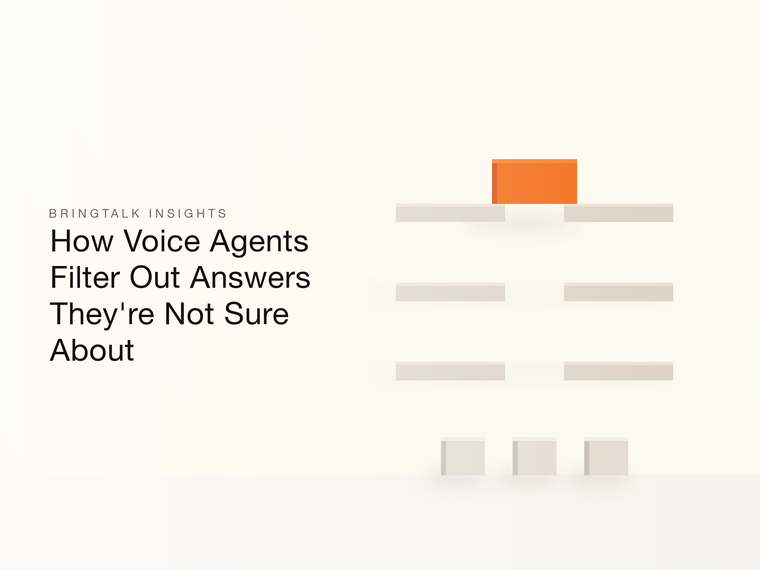
The Three-Layer Filter We Built
1. Before generation — intent confidence check
The agent classifies intent first. Below a threshold it generates nothing and asks: "Could you tell me a bit more?"
2. After generation — rubric self-verification
The draft then passes a rubric: coverage scope, exception conditions, prohibited phrasing. One failed item sends it to an escalation script.
3. Critical Failure hard-stop
Past both layers, certain patterns—inaccurate legal conditions, false warranty commitments, unverified pricing—transfer the call to a person. A hard stop, not a soft escalation.
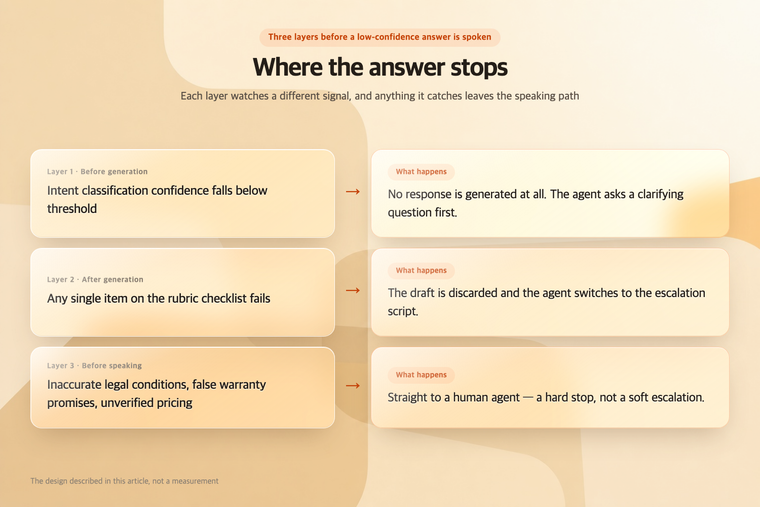
Each layer watches a different signal. This is the design, not a measurement.
Where This Design Breaks Down
Three layers still leave gaps. The most common is an utterance with no single intent: ask two things at once, the classifier picks one with high confidence, and that answer clears the rubric. Being half-right never trips a confidence check.
The rubric fails the same way. A checklist enumerates what's allowed, so a topic nobody listed has nothing to fail against and the answer ships. We add an item when a new inquiry type appears, routing it to a person until then.
Then coverage hours. A hard stop protects only while someone is there to take the call; on a weekend with an empty queue it just ends it. So check the escalation team's hours, and put a callback booking behind it.
The Design Decision That Took the Most Debate
What our team argued over longest was the confidence threshold: too low and the agent pauses on too many questions, too high and low-confidence answers slip through. Our conclusion was to stop fixing one number—thresholds differ by intent type and risk, strict on warranty questions, looser on general guidance.
Handing call work to an outside team adds contract-side checks, collected in Call Center Outsourcing: What to Check Before You Sign.
Filtering low-confidence answers doesn't weaken an agent. It makes it say only what it's allowed to say.