Two Conditions for Turning On Outbound Calling
In H2 2025 Korea's text spam reports fell 59.7% to 12.88 million while voice spam rose to 8.73 million. Whether outbound automation is safe comes down to list provenance and the number of items per call, not send volume.


In the second half of 2025, reported and detected text spam in Korea fell 59.7% to 12.88 million cases. Voice spam moved the other way, rising to 8.73 million.
Anyone automating outbound calls now is switching on the channel that just got louder. That does not postpone outbound; it narrows the conditions.
1. The Two Channels Moved in Opposite Directions
              reports & detections      spam received per person, monthly
total         23.67M cases   -39.0%     10.35 messages   +2.44
text          12.88M cases   -59.7%      2.74 messages   -0.30
voice          8.73M cases   increase    4.26 messages   increase
Source: Korea's Broadcasting and Communications Commission, "Spam Distribution Status, H2 2025" (14 May 2026), covering July–December 2025. Changes are against H1. The total spans categories beyond text and voice, so it exceeds those two rows.
Reports fell 39% while per-person volume rose by 2.44. Bulk sending is filtered out, yet people answer more of these calls than before.
2. What Grew Was Calls With an Open Purpose
The commission attributed the rise to telecom subscription solicitation and similar calls. They share one trait: the purpose is not closed.
You cannot tell what the call is about before answering, or where it ends after. That trait, not send volume, is what gets a call reported. Same automation: an overdue notice goes unreported, a subscription pitch does not.
A call becomes spam at the boundary of its purpose, not at its send volume.
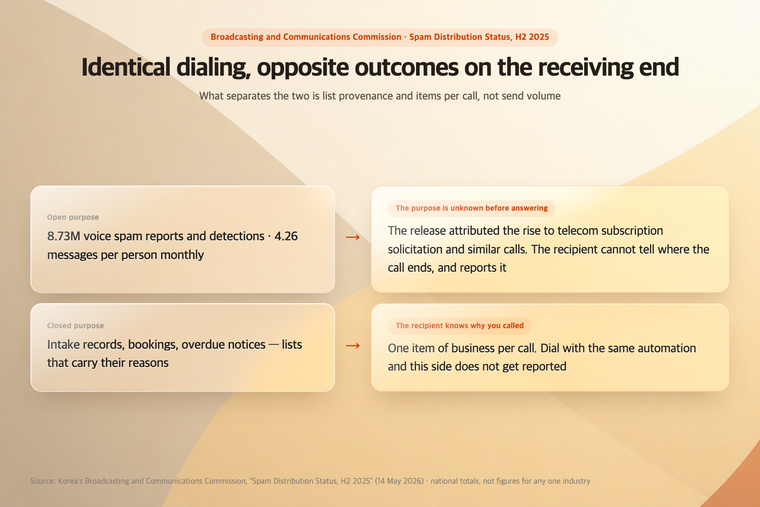
Identical dialing, opposite outcomes on the receiving end. Counts from the commission's H2 2025 release, not any one industry.
3. Two Conditions for Starting With Outbound
Inbound avoids this because the other side placed the call. Outbound needs two things to hold.
- Every number carries a reason. An intake record, a booking, an overdue notice. If that reason lives only in your CRM, it is a cold call to whoever answers
- One call carries one item of business. Confirm and hang up, or notify and hang up. A second item changes the call's character, not its length
BringTalk looks at where the list came from before the script. With unjustified numbers in it, report rates hold however good the conversation is.
4. When These Conditions Do Not Hold
Two situations put outbound behind other work.
- A bought or scraped list. If the call must explain where the number came from, one condition is already broken
- A proposal that needs explaining. Selling something the other side does not know about yet will not close into one item. Automate inbound first and handle these in calls that come to you
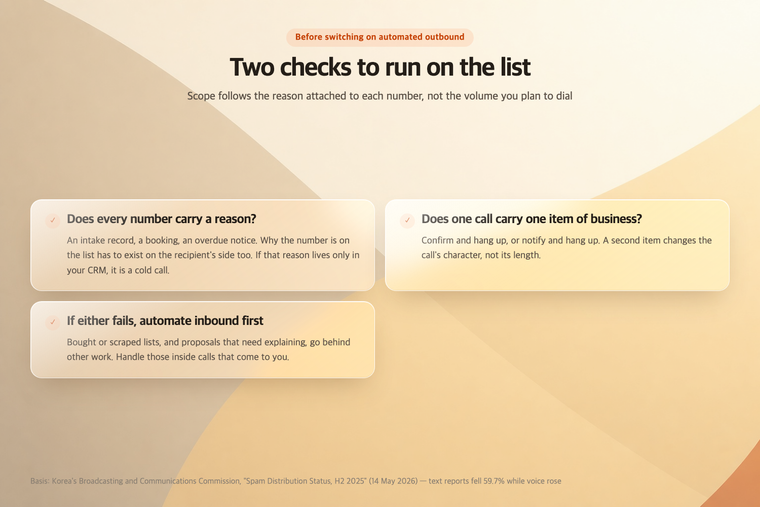
Scope follows list provenance, not planned call volume.
5. Closing
The same release said the commission would push forward a sender qualification scheme and a system for recovering illegal spam proceeds, with no effective date given. The direction points at the sender's standing.
Write one line per number saying why that person would expect a call. What can be automated settles itself.
Baseline: Broadcasting and Communications Commission, "Spam Distribution Status, H2 2025" — voice spam 8.73 million reports and detections, 4.26 messages per person monthly and rising; text down 59.7% to 12.88 million. Outbound readiness is list provenance and items per call.