No-Show Reminder Calls Are a Rebooking Loop, Not a Notice
Korea's revised Consumer Dispute Resolution Standards did more than cap no-show penalties — they made advance disclosure a condition. Here is what that changes for teams measuring reminder calls by delivery rate.

Diners who skip a restaurant booking in Korea can now be charged up to 40% of the bill, under the revised Consumer Dispute Resolution Standards effective 18 December 2025. For anyone running reminder calls, a quieter clause matters more.
1. A Ceiling Means You Have to Show You Gave Notice
The revision splits restaurants in two.
- Reservation-led restaurants (omakase, fine dining): up to 40% of the total bill
- General restaurants: up to 20%
Source: 「음식점 '노쇼' 위약금 최대 40%까지…소비자분쟁해결기준 개정 시행」 (Korean original; "Restaurant No-Show Penalties Up to 40%: Revised Consumer Dispute Resolution Standards Take Effect"), announced by the Korea Fair Trade Commission, Korea Policy Briefing (korea.kr), 18 December 2025. https://www.korea.kr/news/policyNewsView.do?newsId=148956738 (accessed 7 August 2026)
The same announcement attaches a condition: operators must disclose the deposit, penalty, and refund terms in advance, in a form as legible as a text message. So charging 40% turns on whether you can show you said so first. The ceiling is a number; the right to use it is created at booking time.
2. Success Moves From "Sent" to "Answered"
Delivery rate measures what we did, not what the customer did.
A no-show is less an event where someone failed to arrive than one where we failed to hear they could not. Take a six-top on a Saturday. A cancellation landing Friday afternoon gives a day to work the waitlist; the same words at 5pm Saturday leave the table empty. The reminder went out normally both times, so delivery rate scores them identically.
A reminder call ends when you have one of two answers: coming, or not.
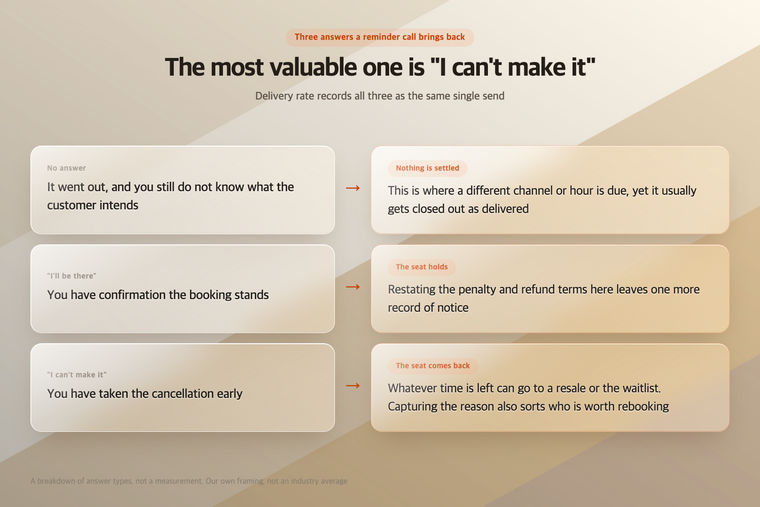
The cancellation is worth the most of the three. Delivery rate cannot tell them apart, so a reminder programme that works and one that spins look like the same number. A breakdown of answer types, compiled by us, not an industry average.
3. The Rebooking Loop
reminder call
  ├ no answer      → retry on a different channel or hour
  ├ "I'll be there" → confirm, restate the terms
  └ "I can't make it" → capture reason + preferred date
                      → resell the slot / call the waitlist
The branch that earns money is the bottom one, and most reminder designs only run the top one: send again, then mark it delivered. Capturing the reason adds a further loop — a customer who cancelled over timing is a rebooking candidate, one who changed their mind is better let go.
4. Where It Snags
- Evidence of notice. What you said on a call is hard to produce later — probably no accident the regulator's example was a text message. Take the answer by phone, confirm in writing.
- Dialling harder to force an answer. Push retry counts up and blocking moves before connect rates do — the mechanism in where auto calls break down.
- Leading with the penalty. Put money first and the call turns into collections.
5. When This Approach Does Not Work
- Slots you cannot resell. Without the back half of the loop, a plain notification is fine.
- Lead times of a few hours. You win the cancellation with no time to refill.
- A ledger in someone's head. If the system cannot say what to confirm, dialling has nothing to confirm.
- Venues taking no deposit. With no penalty to disclose, the notice rule does not bind.
6. What to Take From This
Korea's Ministry of SMEs and Startups reported six in ten restaurant businesses had been hit by a no-show in the previous three years.
Source: 「정부, 소상공인 노쇼 피해 지원에 적극 나선다」 (Korean original; "Government Steps Up Support for Small Business No-Show Damage"), Ministry of SMEs and Startups press release, Korea Policy Briefing (korea.kr), 1 January 2026. The six-in-ten figure is the release's own subheading. https://www.korea.kr/briefing/pressReleaseView.do?newsId=156737813 (accessed 7 August 2026)
At that frequency a no-show is a standing condition, not an accident, and standing conditions are absorbed by a loop rather than staff diligence. Before automating reminders, settle which answer ends the call.
Key figures: Penalty ceilings are 40% for reservation-led restaurants and 20% for general restaurants (Korea Fair Trade Commission, 2025-12-18), and using either requires a record of advance notice. With six in ten restaurant businesses hit by a no-show in three years (Ministry of SMEs and Startups, 2026-01-01), reminder calls should be measured by answers recovered, not messages sent.