What Is an Auto Call? Where Automated Outbound Works and Where It Stalls
An auto call is outbound dialling the system does for you. It runs opposite to IVR and sits on a different layer from a dialler. Where automated outbound lands, and the three places it stalls — blocking, consent and timing, and the silence right after connect.

One button dials 3,000 people. The next morning the report carries two numbers. 3,000 placed, 400 connected.
People who look up auto calling want one of three things: what it is, what it is good for, why it underperforms. In that order, then.
1. An Auto Call Is a Call the System Places for You
An auto call — or autocall — is outbound dialling where the system works the list instead of a person pressing numbers. What happens after the connect is separate: a recording, a live agent, or an AI that carries the conversation.
The vocabulary gets mixed up, which is where proposal comparisons go wrong.
| Term | What it points at |
|---|---|
| Auto call | Any form of automated outbound dialling. An umbrella term |
| IVR | Automated response for calls coming in, navigated by keypad |
| Robocall | One-way playback of a recording. A subset of auto calling |
| Predictive dialler | Hardware that predicts agent availability and places several calls at once |
| Outbound AI agent | Dials automatically and handles the conversation as well |
Why IVR Gets Confused With It
The direction is reversed. IVR answers calls customers place; auto calling places calls at customers. But if the same recorded prompt plays either way, the recipient cannot tell. Hence "I got one of those automated calls" usually meaning outbound.
How a Dialler Differs
A dialler manages pace — ten agents on the floor, fifteen calls placed at once to cut queue time. The silence you get after saying hello twice comes from that. Most of what the market sells as auto calling automates the far end instead. Not competing products. Different layers.
2. The Calls That Work Are the Ones Already Expected
The dividing line is not industry. It is whether the person expected this call.
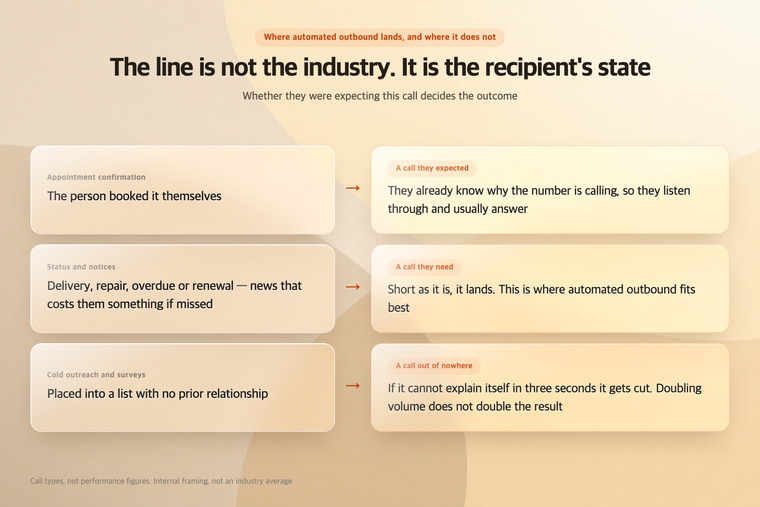
The same automated dial lands differently depending on the recipient.
Where It Lands
- Appointment confirmations, where the person booked it themselves
- Delivery, repair or case-status updates they are waiting on
- Overdue and renewal notices, where not answering costs them something
- Callbacks right after an inbound enquiry
They share one thing: the recipient already knows why the number is calling. So they listen through, and usually answer.
Where It Does Not
- Cold prospecting into a list with no prior relationship
- Surveys that cannot explain themselves in three seconds
- Consultations that must supply new information before the person can act
Doubling dial volume here does not double the result.
3. Raise the Volume and Block Rates Move Before Connect Rates
This is where outbound programmes run aground. Increase dial volume and the first metric to react is not connect rate. It is reports and blocking.
The Recipient's Threshold Has Already Shifted
Korea's Media and Communications Commission published its Spam Distribution Report for H2 2025 on 14 May 2026. Voice spam reports and detections came to 8.73 million for the half. Average voice spam per person ran to 4.26 a month — the highest in five years — while total spam reports and detections fell 39.0% to 23.67 million. Everything else dropped; voice went the other way. (Korea Media and Communications Commission, Spam Distribution Report, H2 2025, 14 May 2026 · KDI Economic Information Center copy, accessed 2026-08-07)
That does not attach to your dialling directly, but the threshold on the receiving end has moved. Someone getting four a month stops answering unknown numbers.
These figures first appeared in Two Conditions for Turning On Outbound Calling. That piece sets the test for whether to switch outbound on at all, while this one stays on what an auto call is and where it breaks. If that decision is still open, start there.
Numbers Wear Out
dial volume ↑
  → high volume from one number in a short window
  → more no-answers and instant hang-ups
  → reports accumulate → carrier filters and handset blocking
  → connect rate for that number ↓
Dial volume is less a throughput setting than a rate at which you burn a number's usable life. When connect rates fall, teams suspect the list first. Swapping it will not recover a blocked number.
4. Timing and Consent Are Requirements, Not Settings
The second trap is treating this as something to tune after the first run. Once commercial advertising enters the call, it stops being a setting.
Article 50 of Korea's Network Act draws three lines:
(1) Consent    Sending commercial advertising through an electronic
               transmission medium requires the recipient's explicit
               prior consent.
               (Exceptions: contact details collected in a transaction,
                used to advertise goods of the same kind; and door-to-door
                sales law telemarketers who disclose where the personal
                data came from)

(3) Night      Between 9pm and 8am the next day, separate prior consent
               is required. The exempt medium is email; voice calls
               are not on that list.

(4) Disclosure The sender's name and contact details, plus an easy way
               to opt out or withdraw consent, must be stated.
(Act on Promotion of Information and Communications Network Utilization and Information Protection, Article 50, accessed 2026-08-07)
The Line You Add to a Confirmation Call
The first failure is deciding a service call cannot be advertising. Finish the confirmation, add a sentence about a new product, and the call has changed character. Check the consent record first.
When Retries Slide Into the Evening
The second is retry scheduling drifting past 9pm with no night consent on file. Calling back after work hours is sensible design, and exactly where it crosses the line.
Paragraph 5 also prohibits obstructing opt-outs, auto-generating contact details, and concealing the sender's identity. Rotating caller IDs to stay ahead of blocking runs into this — which is why answering Section 3 with "get more numbers" does not work.
If an AI handles the call, disclosure adds another requirement — flagged here, not covered.
5. The Silence Right After Connect Creates the Report
The third trap sits after the connect.
When a recipient says hello and hears nothing back, most hang up right there. Some wait one more beat, sure, but proportionally that is what happens. And a share of them report the number, because silence reads as a spam signal.
Three places create it:
- A dialler placed simultaneous calls and found no free agent. The gap before a human arrives is dead air
- The AI is composing its first response. Generating a sentence and rendering it as speech carries as silence
- Answer detection is slow. Judging human or machine delays the first word
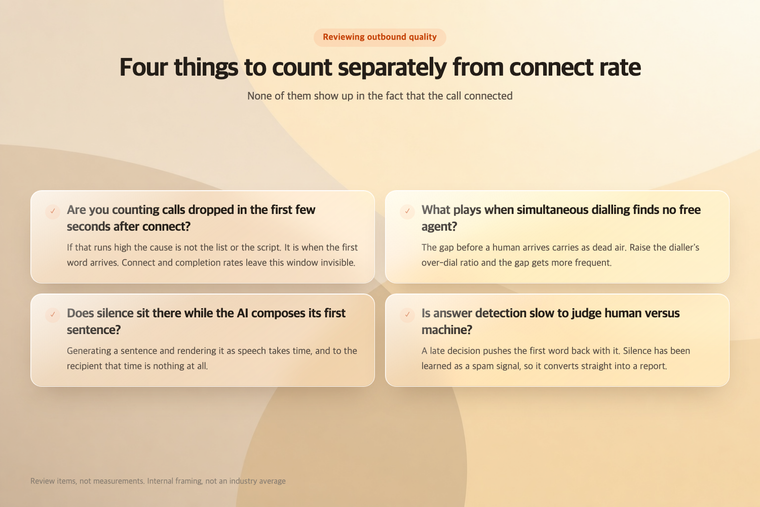
Connect rate alone does not surface any of these four.
Alongside connect and completion rates, count the share of calls dropped in the first few seconds. If that runs high, check when the first word arrives before touching list or script.
To the person answering, call quality is decided less by what was said than by when speech started.
At BringTalk we track this window as its own outbound metric. Miss the moment the first word should land and nothing after it gets heard.
6. When This Approach Does Not Work
Honestly, auto calling is sometimes the wrong tool.
- Dozens of calls a day, each one different. No repeated segment, nothing to remove. The same hours go further on list hygiene
- High-value sales to a small set of contacts. Throughput was never the bottleneck. Preparation per call is
- A list with no clean consent history. Section 4 does not move because you changed tools, and no vendor fixes a list for you
- A caller ID already on block lists. Automation dials it faster and more often
What each vendor packs under the label varies a great deal. That comparison is outside this piece.
7. Summary
Auto calling is an umbrella term for automated outbound. It runs opposite to IVR and sits on a different layer from a dialler. Results turn less on industry than on whether the recipient expected the call.
Three things get in the way. Volume moves reports and blocking before connect rates; timing and consent are requirements, not settings; and the silence right after connect produces the report.
If you have an outbound scenario under review, walk through the list, the calling window, and the first spoken line.
Key figures: Per Korea's Media and Communications Commission Spam Distribution Report for H2 2025 (published 14 May 2026), voice spam reports and detections reached 8.73 million in H2 2025, at 4.26 per person per month — a five-year high. When you raise dial volume, connect rate is not the first thing to move.