What AICC Is — A Component-Level Definition
AICC is not a product name. It is a bundle covering connection, recognition, conversation, integration and record — which is why two quotes never line up.


Get two AICC quotes and the line items often do not overlap. Same word, different goods.
1. AICC is the name of a bundle, not a product
AICC — AI Contact Center — does not point at one piece of software. It names the whole set of functions that answers a call, understands the speech, replies, exchanges values with business systems, and leaves a record behind.
So "we're adopting AICC" does not settle what is being bought. Replacing only the agent desktop is called adopting AICC. So is moving the entire telephony estate. That is the real reason two quotes do not line up.
Read a bundle name as a product name and quote comparison stops being possible.
2. Split it into five layers and less of it is confusing
Left as one lump nothing compares, so split it in the order a call passes through.
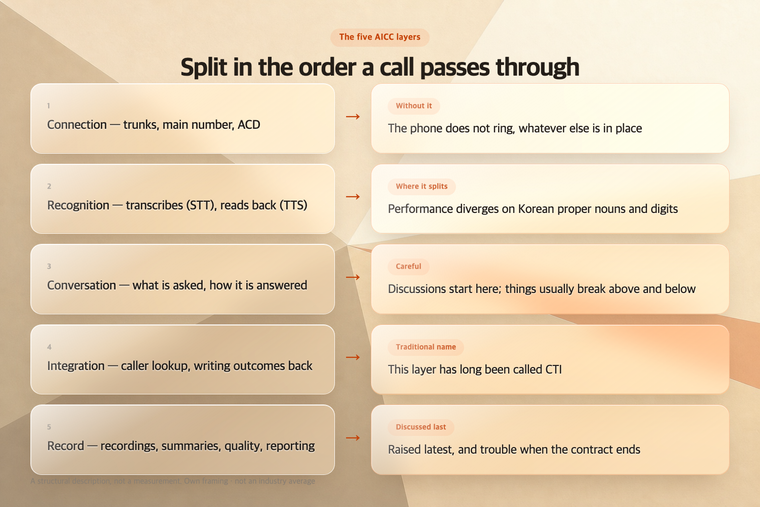
Once there are layers, "how much are we buying" can be written as a boundary instead of a sentence.
The connection layer handles the call itself — trunks, the main number, and the distribution (ACD) that decides which queue a call joins. Without it the phone does not ring, whatever else is in place.
The recognition layer moves between speech and text — transcription (STT) one way, playback (TTS) the other. This is where performance splits on Korean proper nouns and digits.
The conversation layer decides what gets asked and how it is answered. The old IVR script and today's voicebot occupy the same slot. Most adoption discussions start here; what actually breaks is usually above or below.
The integration layer exchanges values with business systems — looking up who the caller is, writing the outcome back. Its traditional name is CTI.
The record layer handles what is left once the call ends: recordings, summaries, quality evaluation, per-queue reporting. It is discussed last during adoption and causes the most trouble when the contract ends.
Five is not the right answer, exactly. Some vendors fold recognition and conversation together; others split record into quality management and reporting. What matters is not the count but whether you can say who owns each layer right now.
3. Vendors really do sell it as one lump
Split into layers, the obvious worry is whether you now buy five things. The market bundles. Genesys Cloud's own overview page lists inbound and outbound voice, secure IVR and callbacks, digital channels, workforce engagement management, voice transcription, Agent Copilot and API requests side by side on a single page. (Genesys, Overview of Genesys Cloud, accessed 2026-08-10)
Buying a bundle is not the problem — one vendor across several layers means less finger-pointing and lower integration cost. The problem is signing without writing down which layers you already own and which arrive new. The quote is itemised in the vendor's selling units; your estate is not organised that way, so overlapping cells stay invisible.
4. Mistake it for a single product and layers arrive twice
The trap that catches people most often. Understand AICC as one product and a layer you already have gets stacked with itself.
The typical shape: the centre already runs an IVR script and a CTI integration, and the new AICC platform brings its own IVR and connector with it. Now there are two scripts — with no decision about which answers first, or whose values to trust on transfer.
It does not show at contract time — the feature matrix marks both as included. Overlap surfaces during parallel running, usually as the same customer verifying their identity twice.
- Layers you have: write the name of the system doing that job today
- Layers arriving: write which function of the new platform takes that slot
- Overlapping layers: write which one gets switched off, and when
Skip the third line and it never gets switched off. With no date it becomes "leave both on and tidy up later" — and that state quietly becomes normal operation. Merging two hardened scripts costs far more than building one to begin with.
5. Write the scope as boundaries
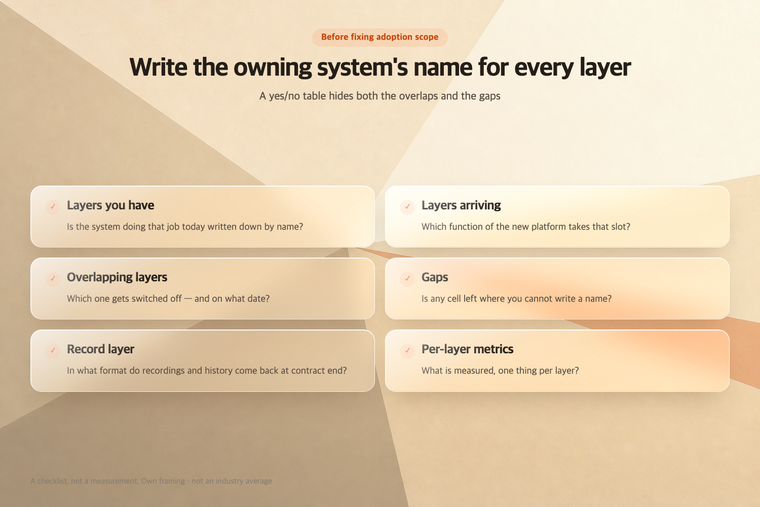
The point of writing scope is not vendor comparison. It is finding overlaps and gaps in advance.
Gaps are what usually gets missed. Overlap at least announces itself during parallel running; a layer nobody owns stays quiet until the day before go-live. The record layer is the usual case — the old equipment handled recording, and after the move those calls simply are not recorded.
Gaps come from "surely they've got it." The incumbent's owner assumes the new platform took it; the new platform's owner assumes the incumbent still runs it. So the layer table should hold the owning system's name, not a yes/no. A cell where you cannot write a name is a gap.
6. Layers change where you look when a metric goes bad
A low connection rate caused by trunks and distribution (connection), by callers repeating themselves until they hang up (recognition), or by a script long enough to lose them midway (conversation) are three different problems.
The integration layer has its own write-up in what CTI is and how call centre integration actually works. This article is closer to a map for asking which layer broke.
To see it per layer, decide in advance what each layer measures: arrivals and abandons per queue, re-prompt counts, drop-off by script step, lookup failure rate, missing-recording counts. The list need not be complete — one metric per layer narrows a cause.
Without layers, one metric attracts five candidate causes. The meeting runs long and the conclusion is usually "let's watch it a bit longer."
7. When this does not work
Honestly, there are places where splitting into layers is overkill.
- No contact centre to speak of yet. One main number forwarded to a mobile has no layers to split. Start by keeping call records, not by designing layers
- Phone is not the main channel. If most enquiries arrive by chat and email, the connection and recognition layers are nearly empty. The same budget goes further on chat automation
- Already committed to one vendor. Splitting responsibility per layer buys less. Even then, check the record layer separately — what format recordings and history come back in at contract end is decided there
In short: AICC is a bundle name covering connection, recognition, conversation, integration and record. Writing adoption scope, start with the layers you already have and the ones that overlap, not the ones arriving. Overlap shows up in parallel running; a layer nobody owns stays quiet until go-live.