Voicebot or Chatbot: What Work Should Stay on the Phone
Chat is live and call volume has not moved. Hands tied, verification required, emotion attached — three criteria for deciding which work stays on a call.

You launched a chatbot and call volume did not move.
Support automation usually runs in one order: deploy chat, then shrink the phone queue. In practice a segment stays on the phone regardless of how well chat performs.
1. It Is Not a Digital Literacy Problem
One assumption has to go first — that people call because they are uncomfortable online.
Korea's Ministry of the Interior and Safety published its 2024 E-Government Service Usage Survey on January 24, 2025. Surveying residents aged 16 to 74 between August 16 and September 30, 2024, it reported 92.0% usage and 97.6% satisfaction. Handling official business online is already ordinary, and phone channels still do not disappear. The reason sits with the work, not the user.
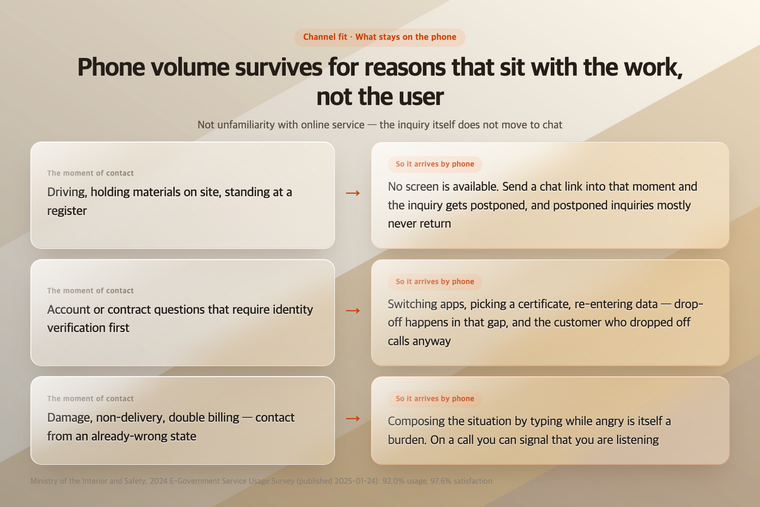
What decides the channel is the situation the inquiry arrives in, not its subject. The 92.0% and 97.6% figures are published survey results, not our own measurements.
2. When Hands Are Busy, It Comes by Phone
The first criterion: are the customer's hands free at the moment of contact.
Driving, holding materials on site, standing at a register — none leave a screen available. Send a chat link into that moment and the inquiry gets postponed, and postponed inquiries mostly never return.
- A field technician checking parts availability
- A delivery driver confirming an address
- Changing a reservation while in transit
3. Identity Verification Does Not Move to Chat
The second criterion is the verification step. Authentication mid-chat means switching apps, picking a certificate, re-entering data. Drop-off happens in that gap, and the customer who dropped off calls anyway — two attempts, so handle time goes up rather than down. On voice, verification continues inside the same conversation.
When a channel switch fails, the call starts over from zero. That costs more than never switching.
4. Emotionally Loaded Inquiries Get Worse When Moved
The third criterion is emotional load. Damage, non-delivery, double billing — contact arriving from an already-wrong state generally degrades in chat.
The reason is sequence, not speed. Chat makes the customer compose the situation by typing, and doing that while angry is itself a burden. On a call you can signal that you are listening. Even when automating this type, take it by voice and predefine when to hand off.
5. When These Criteria Do Not Apply
- Volume in the dozens per day. Splitting channels costs more to design than it earns
- Document-driven B2B inquiries. When quotes and spec sheets move back and forth, voice is the bottleneck
6. Not Better Versus Worse, but What Stays
Hands tied, verification required, emotion attached — filter with those three and keep what remains on the phone.
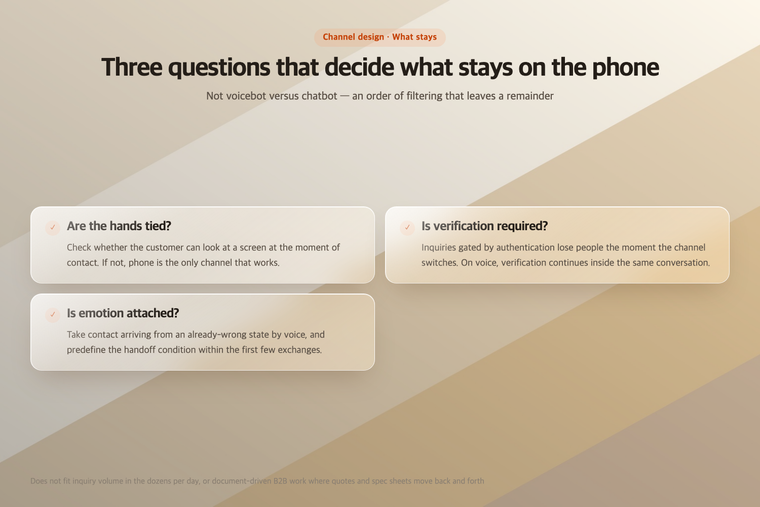
An inquiry that answers "no" to all three can go to chat.
BringTalk starts channel design from those questions, segmenting inquiry types before attaching a voice agent to the ones that stay. If you want to sort your inquiry log against these criteria, we are happy to work through it.
Baseline: Ministry of the Interior and Safety, 2024 E-Government Service Usage Survey — 92.0% usage, 97.6% satisfaction. People do not call because online is unfamiliar. They call because the work has a reason to stay on the phone.