Where Phone Booking Automation Ends
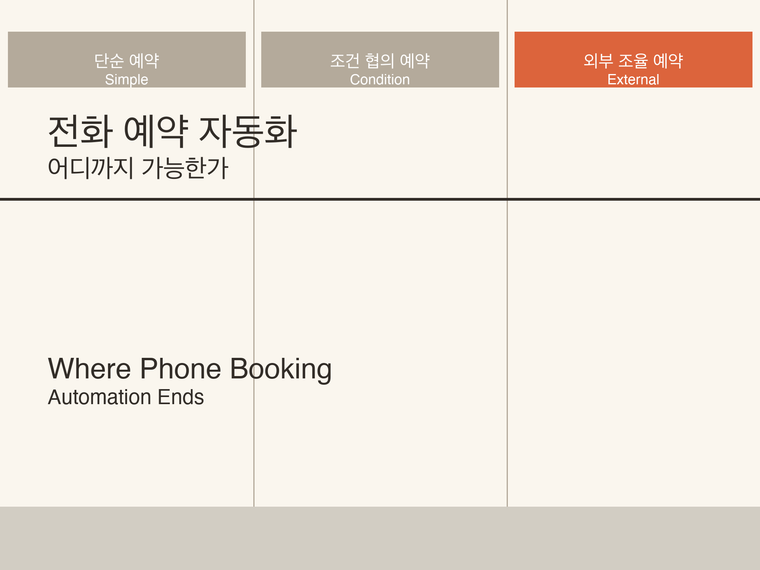
When automating phone bookings with voice AI, the scope differs by booking type. Distinguishing simple, condition-negotiation, and external-coordination bookings clarifies the boundary.

Automating phone bookings with voice AI sounds like a single project — you record a booking over the phone, you automate it. In practice, the types of bookings that can be fully automated and those that cannot are different. Treating them the same leads to systems designed around assumptions that do not hold in the field.
Simple bookings automate well
When a booking means collecting a few fixed items — date, time, party size — and confirming against available slots, voice AI handles it cleanly. The caller knows what they want. The system knows what to check.
Hair salons, restaurants, and initial clinic visits fall here. The agent gathers a defined set of inputs, checks availability, and confirms. The logic is predictable and the failure modes are contained.
Condition-negotiation bookings are harder
Some bookings require trading conditions before they can be confirmed. "Sometime next week works — can you fit me in during the morning?" The caller may not even know all their constraints at the start of the call.
Here the agent has to narrow down requirements through conversation, not just fill fixed slots. That puts more weight on context retention across turns and on how the agent handles partial or shifting input. Automation is possible but the design cost is higher.
Bookings that require external coordination sit outside the line
Some bookings cannot be confirmed until someone internal checks availability — a specific technician's schedule, a third-party system, or inter-department alignment. Appliance installation visits and B2B meetings often work this way.
Voice AI can take the request, but confirmation requires a human follow-up. The system becomes auto-intake with manual confirmation, not full automation. Designing it as end-to-end automated produces broken confirmation flows.
Without the boundary, there is no design basis
When all three types get grouped under "phone booking automation," the system tends to be built as if every booking can be auto-confirmed. Callers receive incorrect confirmations, and staff make correction callbacks afterward.
The right sequence is to classify booking types before designing the system and decide how far auto-confirmation can go. How voice AI works in practice for scheduling is covered in Voice AI for Furniture Service Scheduling.
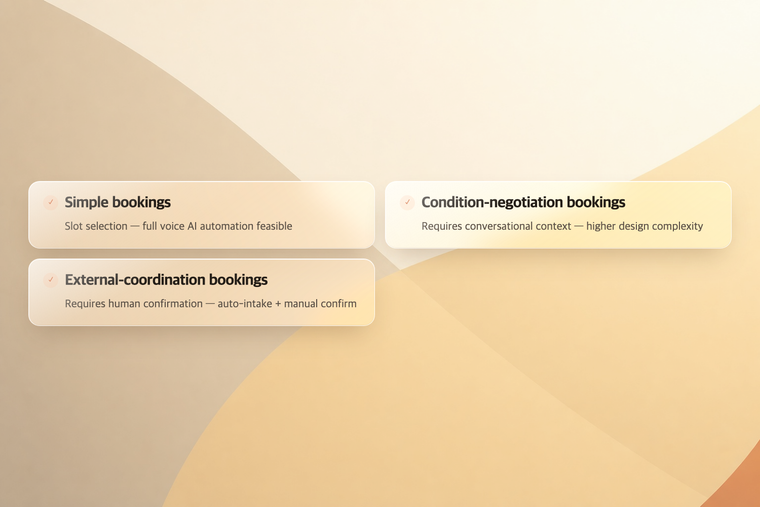
- Simple bookings: slot selection, full voice AI automation feasible
- Condition-negotiation bookings: requires conversational context handling, higher design complexity
- External-coordination bookings: requires human confirmation, auto-intake only
Classifying booking types comes first. Build the system without that classification and out-of-scope scenarios will appear.