What to Check Before Signing a Call Centre Outsourcing Contract
Before comparing vendors, settle the scope and where liability sits. Handing the work over does not hand the liability over.


Evaluating call centre outsourcing usually starts by inviting three vendors and building a comparison table. The more it fills in, the blurrier what is handed over becomes.
1. Write the scope before you compare
Two contracts both called "outsourced support" hold different things. Taking the calls, running the systems on the vendor's stack, handing over quality management — each is a different deal. Skip the scope and each vendor fills the table in whatever unit suits them. Rows that do not line up show only the price.
2. Some of the liability is already fixed by law
Outsourcing customer calls means outsourcing personal-data processing. That part is not negotiated; it is settled.
Korea's Personal Information Protection Act, Article 26, requires processing to be outsourced in a document covering the ban on processing outside the stated purpose and the safeguards in place. The outsourcing party must train and supervise the processor, the processor needs consent to sub-contract, and where the processor causes damage it is treated as the outsourcing party's own employee. (Korean Law Information Center, PIPA Article 26, in force 2023-09-15, accessed 2026-08-10)
Handing the work over does not hand the liability over. The supervision duty stays.
3. Seat-based contracts and AI adoption pull opposite ways
The most common trap. Outsourcing contracts are usually priced by agent seats; AI on the phones moves seat counts down. With no automation clause, you can automate half the calls and still owe the minimum seat commitment — what automation saved converts into a shortfall you pay anyway.
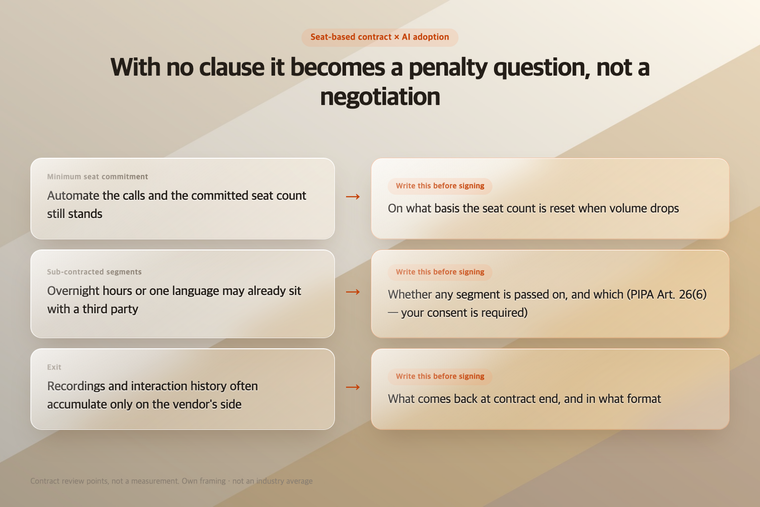
Without a clause it stops being a negotiation and becomes a penalty question.
The longer the term, the bigger this gets. Where the cost actually sits is in where the cost in an AI contact centre comes from.
4. What to put on paper before signing
- Scope — calls, systems, quality management: which of them move
- Data — where recordings and history sit, and in what format they come back
- Sub-contracting — whether the vendor passes any segment on, and which
- Automation — how the seat commitment adjusts when volume drops
- Exit — what you can carry out when you switch vendors or go in-house
Without the last line, the next negotiation has one option.
5. When this does not work
Honestly, there are cases where this much scrutiny is not worth it.
- Fixed-term overflow. For a campaign or a recall, exit clauses buy little — still write down the data return
- A few dozen calls a day. Outsourcing is too much. Decide how missed calls get answered
- Vendor already chosen. If group policy fixes the counterparty, comparison is moot. Attach §2 and §4 as a side agreement
In short: outsourcing is not a contract for renting people. It divides scope and liability. PIPA Article 26 leaves supervision and sub-contracting consent on your side, and a seat-priced contract with no automation clause comes back as a penalty question, not a negotiation.