
When Voice AI Containment Improves but Customer Trust Falls
The next Voice AI operating metric is not containment alone. It is whether the system knows when to resolve, when to escalate, and how to prove that choice.


In AI customer service, ‘what percentage did we automate?’ is no longer a sufficient KPI. Customers remember whether the issue was solved and whether a human appeared when the situation became sensitive.
Containment Is a Trust Metric, Not Only a Cost Metric
Containment means the share of customer requests resolved inside AI or self-service without transferring to a human agent. Used carefully, it reduces repetitive work. Used blindly, it becomes a wall that customers feel trapped behind.
CX Today’s June 15, 2026 article warned that containment-first strategies can raise service cost, weaken loyalty, accelerate churn, and damage long-term brand value when they create poor customer experiences. The same article cited that 40% of consumers stop doing business with a company after a single bad experience, and referenced a Trustpilot and Cebr estimate that negative AI experiences put £8.6B of U.K. e-commerce revenue at risk.
Automation rate can be an efficiency outcome. It cannot replace customer trust.
Voice AI Needs a Trust Gate
Voice AI carries more emotional and timing risk than a text chatbot. Silence, interruption, repeated questions, and vague answers are felt immediately. A customer hears hesitation before they rationalize it.
The operating question therefore changes from “how long can AI hold the customer?” to “when should AI stop?” A trust gate evaluates multiple signals at once.
- Resolution confidence: Does the agent have enough evidence to answer?
- Emotion and urgency: Is the caller angry, anxious, canceling, or reporting a high-risk issue?
- Repetition: Has the same intent appeared twice?
- Authority boundary: Does this require refund, contract, privacy, complaint, or exception handling?
- Context loss: Is CRM, order, or prior-contact context missing?
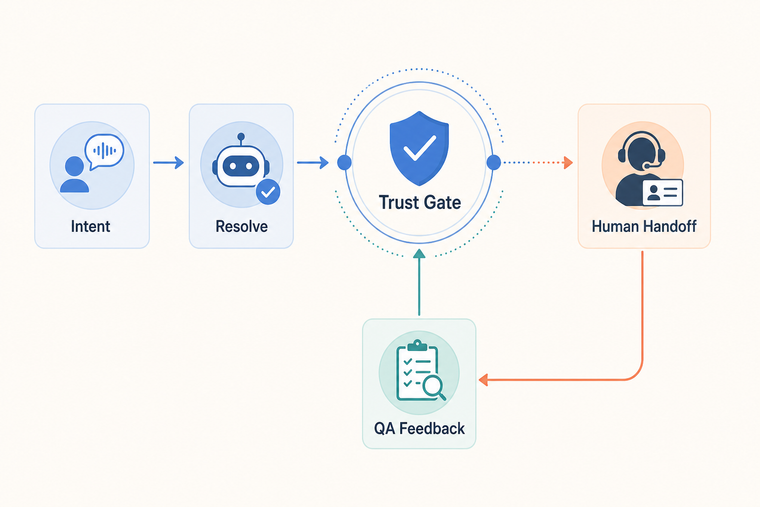
A Good Handoff Is Design, Not Failure
Many companies treat human transfer as an automation failure. In production operations, the opposite is often true. Fast escalation for high-risk customers protects conversion, retention, and complaint cost.
Voice AI containment policy
1. Resolve: FAQ, appointment confirmation, simple status lookup
2. Clarify: unclear intent, one additional information request
3. Trust Gate: emotion, value, authority, and repetition signals
4. Human Handoff: summary, intent, verified data, recommended next action
5. QA Feedback: misroutes, repeated questions, and abandonment reasons update policy
The goal is not just to transfer the call. The goal is to transfer context. The human agent should receive the caller’s intent, authentication state, information already provided, sentiment signals, and next recommended action. Otherwise the customer has to start over, and the handoff feels like a reset.
What IBM and AudioCodes Signal About the Market
On June 18, 2026, IBM listed agent assist in watsonx Orchestrate for contact-center performance in its What’s New updates. On the same date, CX Today covered AudioCodes Live Hub and framed the production challenge for Voice AI as integration with real contact-center infrastructure, not just pilot demos.
The direction is clear. Enterprise Voice AI will not be judged by model demos alone. It must connect with telephony, agent desktop, CRM, QA, and policy boundaries.
- Define which intents AI is allowed to fully resolve.
- Define the risk signals that require immediate human escalation.
- Standardize the summary fields passed to the agent.
- Treat failed calls as operating-policy feedback, not only model-training data.
BringTalk POV: LQA and FUA Work Best on Top of a Trust Gate
BringTalk’s LQA (Lead Qualification Automation) and FUA (Follow-Up Automation) are not just call-volume reducers. They classify intent, timing, and risk so sales teams can focus on high-intent customers.
In an automotive inquiry, AI can handle price range, inventory status, and appointment scheduling. But financing conditions, complaints, contract changes, or repeated uncertainty should trigger a human handoff. At that point the AI should pass not only the call, but the lead score, conversation summary, and next action.
- LQA separates high-intent and high-risk leads.
- FUA reconnects missed and incomplete conversations.
- Context Injection brings CRM and campaign context into the call flow.
- QA Feedback turns failure patterns into updated policy.
Five Decisions for This Week
Before pushing for a higher automation target, operations leaders should document five decisions.
- Which intents AI may resolve end-to-end
- Which emotion, value, and authority signals require human transfer
- Which summary fields must be passed to the human agent
- Which customer-trust metrics sit beside containment rate
- Which weekly QA call samples feed policy changes
Bottom line: The purpose of Voice AI is not to keep customers inside AI. It is to choose the shortest path the customer can trust.