Voice AI Knowledge Updates Need a Five-Step Change-Control Loop
When FAQs, policies, or product conditions change, Voice AI needs a controlled path from verified source to traceable customer answer.


A policy sentence or a product condition can look like a small document edit. For a Voice AI agent, it changes what a customer may hear. Shipping it straight into a prompt or knowledge base is fast, but it makes it difficult to explain which information shaped a particular call.
Knowledge Is an Input to the Customer Channel
FAQs, pricing conditions, return rules, and appointment availability all influence what an agent says to a customer. The fact that a source changed and the decision that an agent may use that change should be separate events.
NIST frames AI risk management as continuous Govern, Map, Measure, and Manage activities. For Voice AI operations, the same discipline can apply to knowledge changes: record the source owner, affected customer journey, validation method, and rollback path.
The test of a fast update is not ‘did it go live immediately?’ It is ‘can we trace and recover it when it is wrong?’
The Five-Step Change-Control Loop
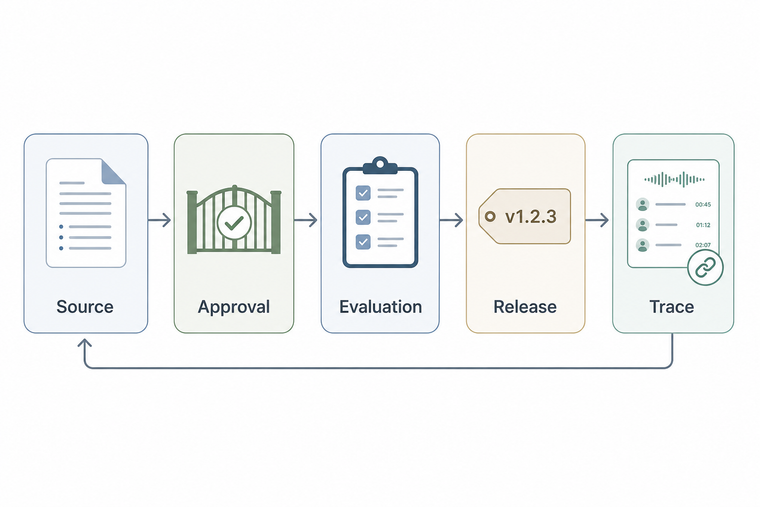
- Source — Receive a change from a system with a clear owner, such as policy operations, CRM, inventory, or booking. A copied message or chat summary is not the source of truth.
- Approval — Confirm which wording is allowed in a customer conversation. Information that changes a customer’s next action—price, eligibility, refunds, or promised timing—needs an accountable approver.
- Evaluation — Test representative and boundary questions. Include normal questions, requests for unavailable information, questions about the prior policy, and cases that require human handoff.
- Release — Deploy with a recorded version and scope. When the platform allows it, start with a narrowly approved journey rather than every call at once.
- Trace — Without copying unnecessary customer-sensitive data, connect a call to the knowledge or policy version that informed its answer.
Evaluation Must Test More Than Correct Answers
A knowledge change can fail without stating a false fact. It can guess when the current information is unavailable, promise something outside its authority, or continue automating a case that should be handed to a person. OWASP LLM06:2025 cautions that excessive functionality, permissions, and autonomy expand agent risk.
Representative question  → Does it explain the new policy correctly?
Boundary question        → Does it avoid guessing when information is missing?
Action request           → Does it avoid promises outside its approved scope?
Exception case           → Does it hand off to a person or formal channel?
OpenAI’s evaluation guidance also emphasizes task-specific, continuous evaluation. The useful asset here is not a giant generic benchmark; it is a small, repeatable test set tied to the customer journeys currently in production.
Four Decisions the Operating Team Needs First
- Source: Which system is the current authority for this answer?
- Approval: Which changes cannot ship without business approval?
- Stop: Which answer failures must halt automation and trigger handoff?
- Evidence: When a customer asks, which version and change record can the team inspect?
Without these decisions, a knowledge base remains a document collection. With them, Context Injection becomes a controlled operating layer that connects current customer and operational data at the moment it is needed.
The BringTalk View: Design Speed and Trust Together
Enterprises need to respond inside the Golden Time, but a fast answer cannot become an unapproved promise. Operating knowledge as source → approval → evaluation → release → trace lets customers get answers sooner while giving the operating team a way to explain where each answer came from.
Takeaway: Voice AI knowledge is a deployable asset. Update speed becomes trustworthy operating speed only when approval, evaluation, and traceability stay connected.
Sources
- NIST, AI Risk Management Framework (2023) — https://www.nist.gov/itl/ai-risk-management-framework
- NIST, Generative AI Profile (AI 600-1) (2024) — https://tsapps.nist.gov/publication/get_pdf.cfm?pub_id=957727
- OWASP, LLM06:2025 Excessive Agency (2025) — https://genai.owasp.org/llmrisk/llm062025-excessive-agency/
- OpenAI, Evaluation best practices (accessed 2026-07-13) — https://developers.openai.com/api/docs/guides/evals