How Voice AI Re-engages Lost Leads in the Used Car Industry: The Cars24 Case
What the Cars24 case reveals about using Voice AI across test drives, vehicle inspections, financing, and lead re-engagement in automotive and used-car operations.


Buying or selling a car rarely ends with a single click. Customers compare models, schedule test drives, review documents and financing, then often pause before deciding. In automotive and used-car operations, conversion is frequently decided in the next conversation—not on the product page.
In an OpenAI customer story, Cars24 says it uses voice and chat agents across buying, selling, financing, follow-up, and support, handling more than one million AI conversation minutes per month. This is a vendor-published customer case, not an independently audited industry benchmark. Still, it offers a useful view of where AI can create operational value in the used-car industry.
The bottleneck is the conversation before the decision
Used-car buyers do not only name a model. They bring a household situation, commuting needs, budget, preferred fuel type, and sometimes a vehicle to sell. Sellers also move through vehicle details, an inspection booking, reminders, rescheduling, and price expectations.
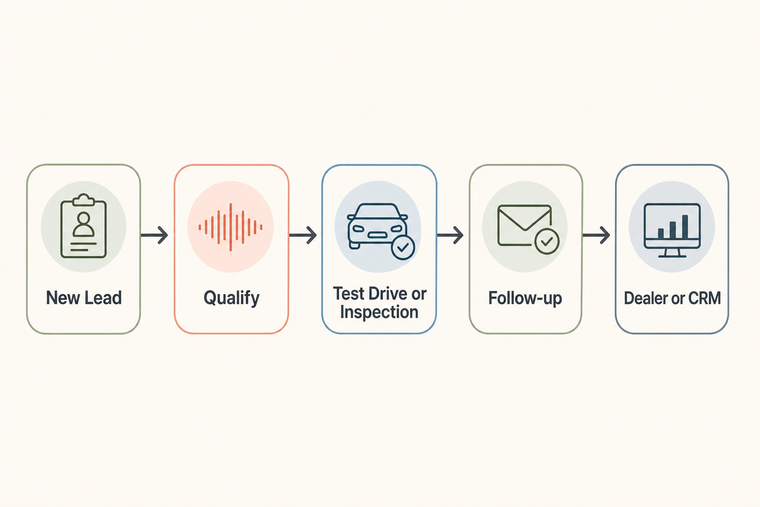
In the Cars24 case, a buyer-facing agent asks about budget, family size, commute, and vehicle preference; recommends cars from the catalogue; then connects the customer to a test drive and financing exploration. A seller-facing agent collects vehicle details, schedules an inspection, and supports reminders or rescheduling for missed appointments.
In automotive and used-car operations, the important question is not whether AI had a conversation. It is whether the next step—test drive, inspection, financing, or follow-up—was connected into one operational flow.
Voice AI is closer to a lead-operations layer than a chatbot
Automotive leads do not end quickly. Before a test drive, the visit needs confirmation. After it, a customer may compare another model or reconsider financing. A seller can miss an inspection or decide to sell elsewhere.
Cars24 explains that its agents re-engage leads that had dropped out after 10 days, qualify renewed intent, and return those customers to the funnel when the company can serve the price they seek. The lesson is not to place more calls indiscriminately.
- Separate customer states. New inquiry, test drive booked, no-show, post-test-drive review, and inspection pending each require a different next action.
- Give each conversation one purpose. Confirm the test drive, reschedule, complete vehicle details, or check renewed purchase intent.
- Write the result into the next system. A call summary is not enough; the outcome should create a booking, dealer assignment, or CRM follow-up.
Three design priorities for the automotive industry
1. Start with conversion events, not vehicle recommendations
An agent that simply answers “Which car should I choose?” is not sufficient. Define the events that create movement—test-drive booking, vehicle-inspection visit, or financing-document confirmation—then design the conversation around them.
2. Define the human handoff
Price negotiation, complex financing, complaints and returns, and regulatory questions are moments for people. The role of Voice AI is not to remove people; it is to hand them the right context at the right time.
3. Make the reason and timing for re-engagement explicit
Repeating the same message to dormant leads damages trust. Recent test-drive status, a changed model preference, a missed booking, or a relevant price condition can provide a reason to reconnect—but consent and contact scope must be governed in the data.
Why a case-study KPI should not become your KPI
Cars24 also reports, in the OpenAI customer story, that it has deployed ChatGPT Enterprise and Codex to about 600 employees in its central organization, with 85–90% daily active usage. Those figures describe one company’s published experience. They are neither an automotive-industry average nor a performance promise from BringTalk.
For an automotive or used-car business, the useful measures are the connections in its own operating flow:
- Time from lead arrival to first response and real connection
- Test-drive or inspection confirmation rate and no-show rate
- Re-entry rate after re-engaging dormant leads
- Completion rate after an AI-to-advisor or dealer handoff
BringTalk’s view: conversation quality is proved by the next action
Voice AI in automotive operations is not a tool for reading vehicle information aloud. It is an operating layer that helps a customer move to the next decision. Evaluation therefore cannot stop at natural-sounding speech. It should verify that bookings are created accurately, that the right context reaches the next owner, and that re-engagement does not damage the customer experience.
Key signal: Cars24 says it handles more than one million AI conversation minutes monthly in the OpenAI customer story. The starting point for automotive and used-car operators is not to copy that volume, but to connect one flow—test drive, inspection, financing, or re-engagement—end to end and make it measurable.
Source
- OpenAI, “How Cars24 scales conversations and builds faster with OpenAI” (Cars24 customer story, accessed July 17, 2026): https://openai.com/index/cars24/