Why Voice AI Needs More Than WER: Three Lessons From VoiceEQ
Hume AI and Hugging Face’s Real World VoiceEQ argues that Voice AI should be evaluated not by transcription accuracy or audio quality alone, but by the quality of the conversation people actually experience.


Voice AI is transcribing more accurately and speaking more naturally. But in a real call, users do not judge a system by word error rate or audio quality alone. They judge whether it understood them, noticed hesitation or frustration, and responded appropriately.
Real World VoiceEQ asks a different question: not how well Voice AI speaks, but how well it listens, understands, and responds as experienced by people.
1. Transcripts Leave Out Critical Signals
Consider a support agent asking, ‘Do you recognize this transaction?’ A clear ‘yes’ and a hesitant ‘...yes’ can produce the same transcript. To a human listener, however, pacing, silence, tone, and emphasis carry very different meaning.
Traditional speech evaluation has focused on quantitative measures such as word error rate (WER), audio quality, and latency. Those measures remain necessary, but they cannot fully describe conversational trust. The Hume AI and Hugging Face authors argue that voice models can receive audio while still relying heavily on transcripts, missing paralinguistic signals such as hesitation, emphasis, pacing, and volume.
2. Teams Need a Quality Map, Not One “Best” Model
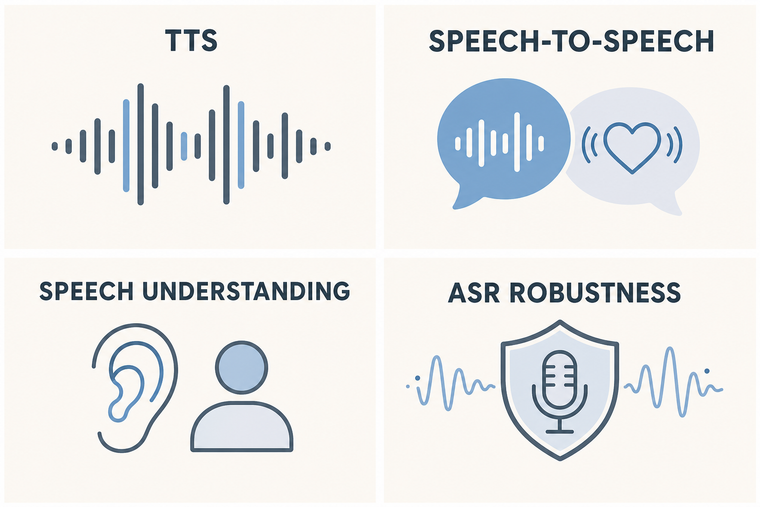
Real World VoiceEQ evaluates ASR, TTS, speech-to-speech, and speech understanding. It covers more than 40 proprietary and open-source voice models across 15+ evaluation dimensions and 60+ metrics. According to the authors, it is built from more than one million individual human ratings collected across demographics, speaking styles, and acoustic conditions, including 785,000 TTS ratings and 48,000 speech-to-speech ratings.
The framework is useful because it does not collapse every capability into a single score. In its TTS evaluations, no system configuration ranked in the top five across all seven capability groups.
- Accurate delivery of numbers and proper nouns
- Recognition of emotion and uncertainty
- Natural, context-appropriate speech
- Robustness to noise, accents, and overlapping speakers
- Consistent speaker identity across longer conversations
These are different capabilities. A reservation agent, a fraud-support line, and a complaint-handling assistant should not optimize for the same failure modes.
3. What VoiceEQ Actually Measures
This is not just a broader label for quality. In its technical report, VoiceEQ separates four kinds of production failure.
- TTS: Acting and role fit, expressiveness, voice identity, language stability, reliable reading of numbers, pharmaceutical terms, and structured data, long-form speaker stability, and acoustic quality. “Natural” therefore means more than clear pronunciation: the system must carry out requested emotion, sarcasm, or emphasis while retaining the same voice and delivering critical content correctly.
- Speech-to-Speech: Whether the agent understands ambiguous tone, aligns its response to emotion when words and vocal delivery conflict, stays useful and natural with degraded audio, urgent users, or hostile users, and redirects the conversation toward resolution. It tests not whether a system receives audio, but whether it uses audio in its decisions.
- Speech Understanding: Emotion and intensity recognition, speaker matching, and synthetic-speech detection independent of transcription. This is the perceptual layer relevant to service quality and voice-fraud defenses.
- ASR Robustness: How WER changes across accents, emotional speech, background music or noise, and conversational overlap. This is transcription reliability under operating conditions, not studio audio.
The reading rule matters too. VoiceEQ uses human listeners and task-specific rubrics for TTS and speech-to-speech, while Speech Understanding and ASR use ground-truth labels or WER. Its design deliberately avoids collapsing incompatible measures into one score.
4. Automation and Human Listening Have Different Jobs
Automated evaluation can rapidly test well-defined questions, such as pronunciation accuracy. Human listeners remain essential when the judgment depends on acoustic and social context: whether a voice suits a role, conveys the right emotion, or sounds like the same person across a conversation. The VoiceEQ authors likewise report that agreement between automated evaluators and trained human raters can decline on more subjective assessments.
This benchmark should not be read as an absolute ranking of every model. Dataset composition, task design, and the evaluator pool all affect results. Its core implication is more practical: a strong WER or MOS does not guarantee a call experience that customers trust.
The BringTalk View: Build a Quality Operating System
Companies do not need only the highest-ranked model. They need a quality system built around moments their own calls cannot afford to get wrong.
Define the call goal → collect failure moments → measure automated metrics →
run human listening evaluations → tune model, prompt, and handoff policy → re-evaluate in production
For reservation or support agents, that means testing more than dates and reference numbers. Teams should also test hesitation detection, tone during complaints, the naturalness of confirmation, and consistency over a long call. Those criteria should come from the real customer journey, not from a generic leaderboard.
The next Voice AI competition is not only about voice quality. It is about the operating quality to read pace, silence, emotion, and context—and respond appropriately.
Source
- Hume AI × Hugging Face, Introducing Real World VoiceEQ: Measuring the human quality of voice AI, July 15, 2026
- Hume AI, Real World VoiceEQ Technical Report
- Figures and interpretations above are based on the public announcement. Methodological details and leaderboard results should be checked against the linked technical material.