Real Estate Inquiry Automation Starts With the Listing
Korea's transport ministry reviewed 1,100 listing advertisements and flagged 321. Of those, 155 were required fields left blank. Blanks are what an automated agent can fill; wrong values are what it spreads.


In summer 2025 Korea's transport ministry reviewed 1,100 online property listings around ten university districts. It flagged 321 as suspected violations, and nearly half were not wrong information. They were missing information.
More agencies are automating listing inquiries. Many of those calls exist because a required field was left blank.
1. The 321 Flagged Listings Were Not One Group
Between 21 July and 22 August 2025 the ministry monitored 1,100 listing advertisements across ten university districts in Seoul, Daejeon, Busan and Gyeonggi. The 321 flagged cases split into two groups.
Improper advertising    166   price, floor area or financing stated inaccurately
Disclosure omissions    155   required fields such as location or maintenance fees left out
──────────────────────────────────────────────────────────────
Suspected violations    321   about 29% of the 1,100 listings monitored
Source: Ministry of Land, Infrastructure and Transport monitoring, published 10 October 2025. The 166 and 155 counts are 51.7% and 48.3% of the 321 flagged cases — not of the 1,100 monitored.
2. A Blank Field and a Wrong Field Reach the Phone Differently
A disclosure omission means the information is absent. Leave the maintenance fee blank and callers ring to ask about it. Predictable question, fixed answer, no person required — that is where automated answering earns its place.
Improper advertising means the information is wrong. Automate on top of it and you read a wrong number back faster and more consistently — the rare case where better answering makes things worse.
Automation over a blank field buys time. Automation over a wrong field distributes the error.
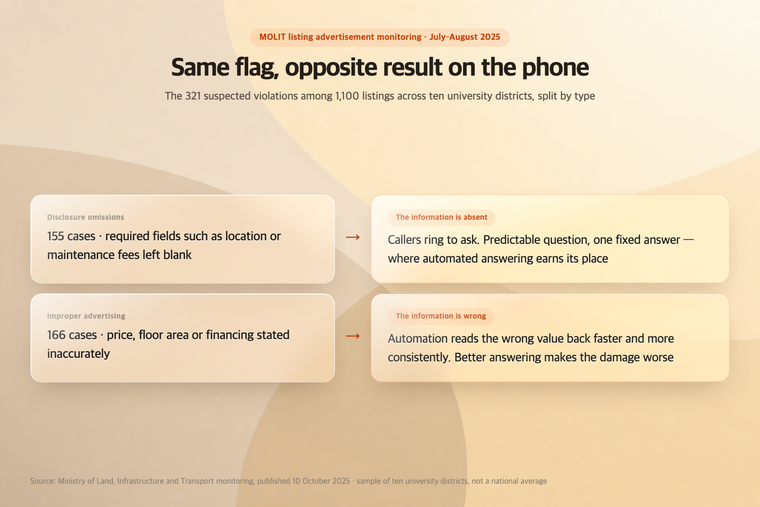
Both are flagged violations, but automation has to treat them in opposite ways. Counts are from the ministry's 2025 monitoring, not a national average.
3. Which Reverses the Order of Work
Inquiry automation usually starts by designing the answering flow. This finding puts that second.
- Count the blanks first. The disclosure standard in force since 1 January 2025 (MOLIT Notice 2024-748) also requires flagging illegal-structure status on listings registered after that date
- Route only inquiries the listing can answer. If reading back a published value ends the call, it belongs to the agent
- Leave the rest with people. Property condition, negotiated terms and owner circumstances were never in the listing
Hold that order and the agent reads the same data the listing publishes.
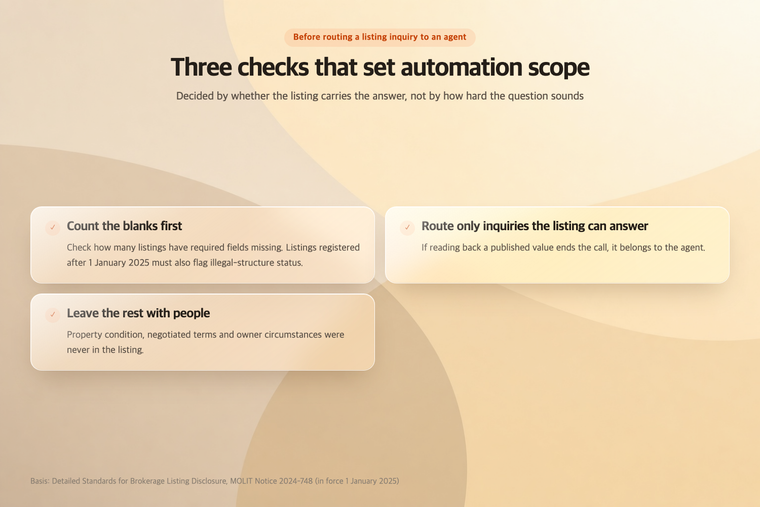
Scope follows whether the listing carries the answer, not how hard the question sounds.
BringTalk looks at the share of blank fields before the answering script.
4. When This Does Not Apply
Two situations put listing cleanup behind other work.
- Stock that turns over daily. In peak rental season listings move faster than fields can be filled
- Calls that negotiate rather than confirm. No amount of disclosure answers a caller who wants different terms
5. Closing
Listing inquiry automation is decided by the listing data, not the answering script. If you can say how many live listings have required fields blank, the scope usually settles itself.
Happy to walk your listing data through this test.
Baseline: MOLIT monitoring, 21 July – 22 August 2025 — 321 suspected violations among 1,100 listings, 155 of them disclosure omissions. Blanks are what an agent can fill; errors are what it spreads.