Where Phone Handling Still Needs a Person
A handling manual records what to say and never records when not to say it. The moment that blank moves into a prompt, the handling drifts.

Automating phone handling starts with the manual. Every situation already has its line, so lifting it looks like the whole job. One item never made it into the manual: when the line should not be used.
The Branch Lives in Someone's Head
Manuals stack up densely as "when this comes in, say this." When to withhold a line is never written. Agents skip on instinct, reading tone or a previous ticket. That judgment runs in someone's head and leaves no trace in the document.
Move the sentences into a prompt and the same guidance goes out once conditions no longer hold. The pause — "this one's a bit different" — disappears. Half a call's quality lived there, and what was never written never transfers. What breaks automation is usually an ordinary variant the manual never anticipated.
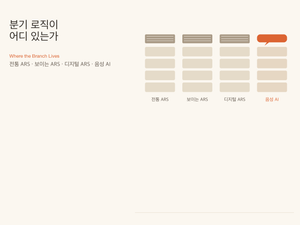
The work before migrating runs line by line: ask when each sentence should be withheld, then write that in as a condition. Summarising hides this rather than exposing it. IVR scripts break the same way, written up in what to keep when you replace an IVR with AI.
Three Layers, Set by the Cost of Undoing
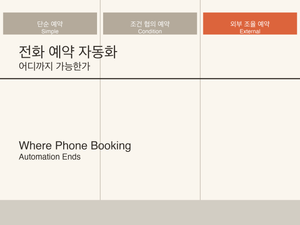
The boundary is drawn at the cost of undoing a mistake. Misstate the opening hours and the next sentence fixes it. An outcome is different. Misreport it and the call is over, and the caller leaves on what they heard.
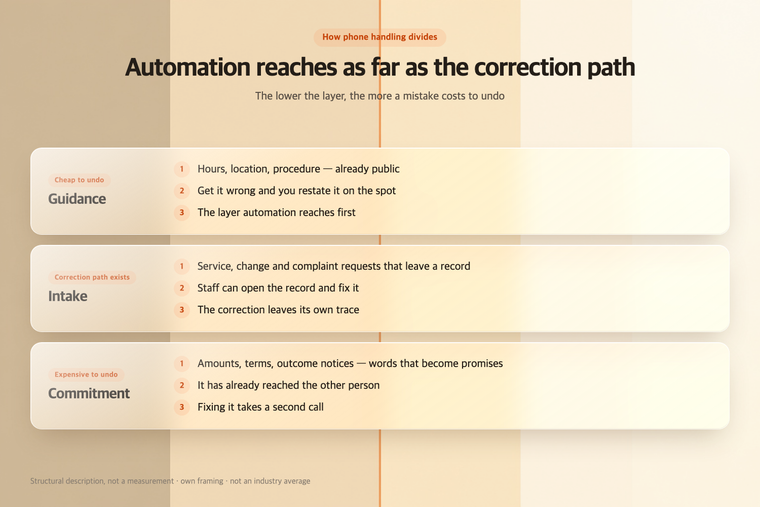
Call length does not separate these three; whether a correction path survives does.
Guidance can be restated. Intake leaves a record staff can open and fix, and that correction leaves its own trace. Commitment is different. The promise has landed, so fixing it takes a second call that usually opens with an apology. How far to push automation comes down to which layer a call falls in.
Where People Stay
- Notifications with no correction path. A call announcing an outcome is final the moment it lands, and the wrong one leaves no way back.
- Amounts and terms. Say a number and guidance becomes a promise. Automate the lookup; let a person carry the confirmation.
- Leave the handover undefined and the agent picks whichever sentence looks closest. Decide in advance where an uncovered request goes. An obviously wrong answer gets caught. The trouble is the plausible one, which stays in place and is far harder to fix.
When This Does Not Apply
There are desks where the distinction buys nothing. Where one or two people handle every call, judgment lives in their heads and volume is low, so migrating costs more than it saves. The same goes for a company with no manual: nothing exists to move, so sorting recordings by type comes first.
Past twenty inquiry types, group them before layering, or the migration becomes dozens of branches.
Automation in phone handling stops once the correction path ends. Before moving the manual, write down when each line goes unsaid.