Why Furniture Service Intake Is Still a Phone Job
A furniture service date needs people, parts, and site conditions to line up at once, so it never closes in one call. Where the disputes cluster, and how to slice the calls by purpose.

The sofa never arrived.
Anyone who has bought furniture online knows what comes next. You check tracking, the status has not moved, you end up calling. The purchase was online; the moment it goes wrong, the touchpoint shifts to the phone.
1. Disputes Cluster Around Scheduling
A Korea Consumer Agency survey published June 16, 2026 shows where the friction sits. Between 2021 and 2025 the agency received 1,052 damage-relief applications related to delivery of furniture bought online. Of the 239 filed in 2025:
- Delayed or undelivered: 26.4% (63 cases)
- Excessive penalty or return fees: 22.2% (53 cases)
- Damaged in transit: 20.1% (48 cases)
One clarification matters. These are damage-relief filing statistics, not call volume statistics. They show where disputes originate — and two of the top three sit on scheduling and logistics. The release also reviewed 29 products across the six companies with the most filings: five did not properly disclose delivery procedures, and only two stated return fee amounts.
2. This Booking Is Tied to Three Things at Once
One service date requires three things to line up simultaneously.
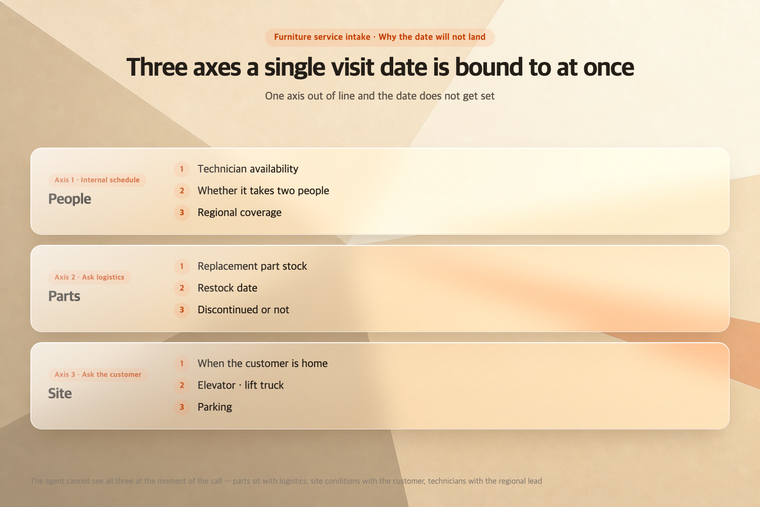
The point is that the three axes sit with three different people. That is why one call does not settle a date.
Any one being off means no date, and the agent on the call cannot see all three — restock dates live with logistics, technician assignment with the territory owner. So one request never closes in one call: intake, a callback after parts are checked, a date negotiation, a confirmation.
The problem is not that calls run long. It is that one job scatters across several calls.
3. Slice the Calls and the Automatable Piece Appears
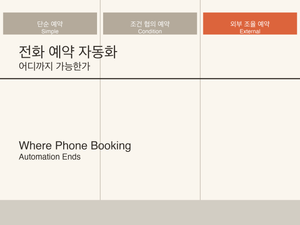
"Automate the service intake call" fails as a unit, because none of the three axes can be settled while the call is happening. BringTalk splits these calls by purpose first.
- Intake — symptom, product, purchase date, site conditions. Nothing needs confirming, so automation fits best here
- Confirmation — once a restock date exists, call out with candidate dates and have the customer pick. Outbound, bounded choice set, automates cleanly
- Coordination — same-day delays and site surprises. A person takes these
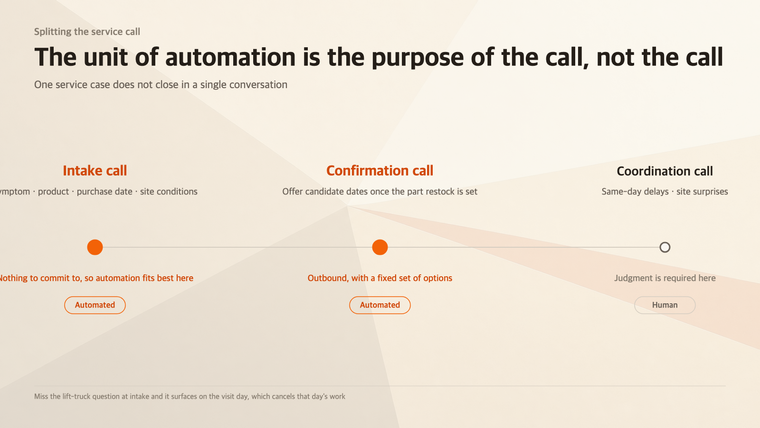
Automation fits where nothing has to be committed to, and where the choice set is already fixed. The judgment step does not move.
Capturing site conditions completely at intake is the critical part. Miss the lift truck question and it surfaces on the day of the visit, cancelling it.
4. When This Does Not Work
- Parts inventory not in a system. Step 2 exists only if a restock date is machine-readable
- High made-to-order volume. Specifications differ every time, so candidate dates cannot be generated mechanically
5. The Unit of Automation Is Purpose, Not the Call
Furniture service stays on the phone because scheduling binds people, parts, and site conditions at once. Automate intake and confirmation, leave coordination to a person, and customers repeat themselves less while agents sit only on calls needing judgment. If you want to sort your service call log by purpose, we are happy to work through it.
Source: Korea Consumer Agency, online furniture purchase survey (June 16, 2026). Disclosure review sample: 29 products across six companies' own stores.