A Support Structure That Splits Time Zones From Languages
Time zone is when the call gets answered. Language is who answers it. Split them and combinations appear.

Open an entity abroad and two things hit the support line at once: their daytime is your night, and enquiries arrive in another language. One problem, two fixes.
1. Keep the two together and no answer appears
Time zones are about when the call gets answered. Language is about who answers it. Bundle them and two options remain: staff locally, or run night shifts from head office. Split them and combinations appear — nights automated with only the language handoff human, or everything automated with people staffed for one window.
Putting someone on nights and answering the phone at night are different decisions.
2. There are three cover structures, and volume is not how you pick
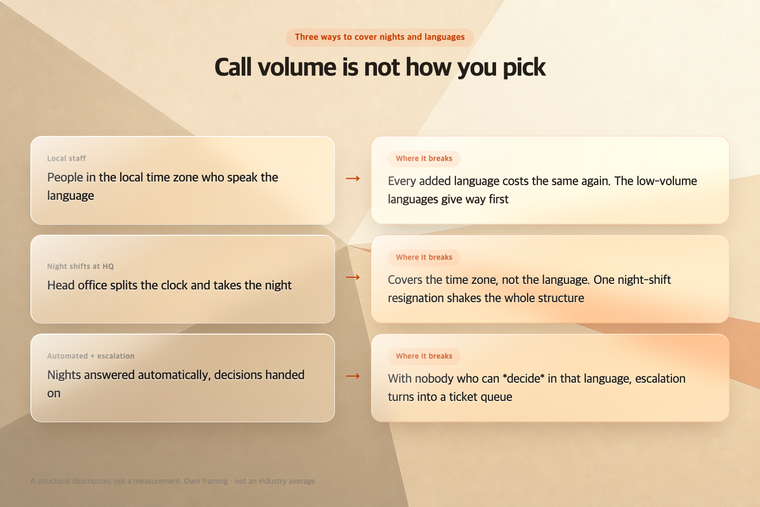
What decides it is not call volume but whether decisions arrive in that window.
Small night volume can still carry requests that are hard to undo; large night volume can be all lookups. The test is whether calls requiring a decision arrive in that window. If not, an automated response and next-business-day handling suffices. If so, someone who can decide in that language must be awake.
3. The same structure is now needed domestically
Not only for firms expanding abroad. Korea's Ministry of Justice puts the foreign resident population at 2,783,247 as of end-2025, of which 2,159,052 are long-term residents, up 5.0% year on year. (Ministry of Justice, foreign resident statistics, accessed 2026-08-10)
These are background statistics, not our clients' call data, and they do not convert into enquiry volume. What the long-term share — over three quarters — says is that a company operating only in Korea will still take contract and refund enquiries in another language. No time-zone problem, only language.
4. Adding a language is not a translation job
The point people most often get caught on. Treat a new language as prompt translation and the call gets answered, but nothing after it moves. One more language means one more escalation path. With nobody who can judge in that language the call ends at "someone will get back to you," the customer rings again, and that repeat lands as a new enquiry — so adding a language looks like volume went up.
A vendor's version of this is in a retail case of multilingual voice AI in production — a case report; this is the decision before it.
5. When this does not work
Honestly, splitting it this finely is sometimes unnecessary.
- Local regulation names who must respond. In finance or healthcare the law fixes who handles the call, so options narrow first — check the rules before the structure
- Only one language added. If it is just English, bolt it onto the existing team
- Under three hours of difference. If an extra hour at each end covers it, skip the night structure
In short: time zone is when it gets answered, language is who answers. Split them and the choice narrows to one test — do decisions arrive in that window.