How Does a Phone Number Reach Voice AI? A Beginner’s Guide to Internet Telephony, SIP, and PBX
A phone number is an address; the call route is the road. Learn how a call crosses telephone networks, SIP, and RTP before reaching voice AI.

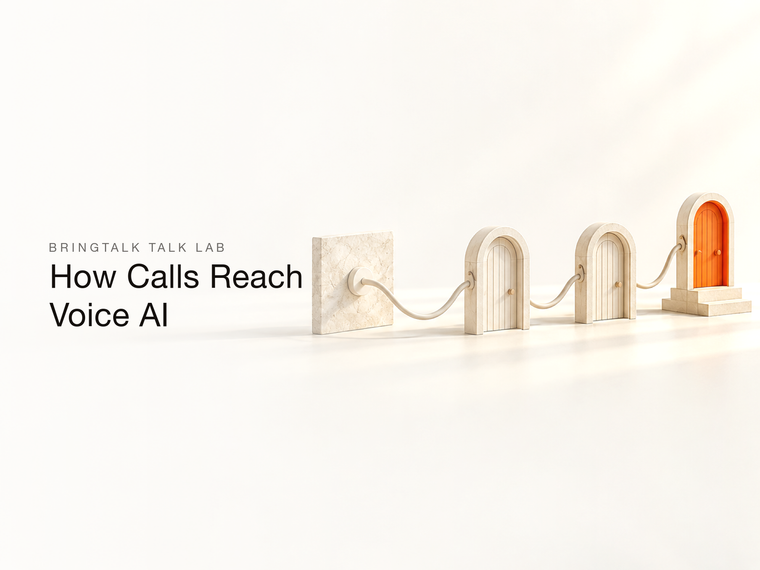
If you buy an internet phone number, can you paste that number into a voice AI and start receiving calls? It is an easy assumption to make. A mobile phone works as soon as a new number is activated, so a server can seem as if it should work the same way.
In practice, a phone number and a call route are separate things. A phone number is like a street address. The call route is the road that reaches it. Creating an address does not automatically build the road. SIP (Session Initiation Protocol, the rules that open and close internet calls) and PBX (Private Branch Exchange, a private switchboard that distributes company calls) perform different jobs along that road. For a call to reach a company system or voice AI instead of a handset, the telephone network responsible for the number must provide a path to that destination.
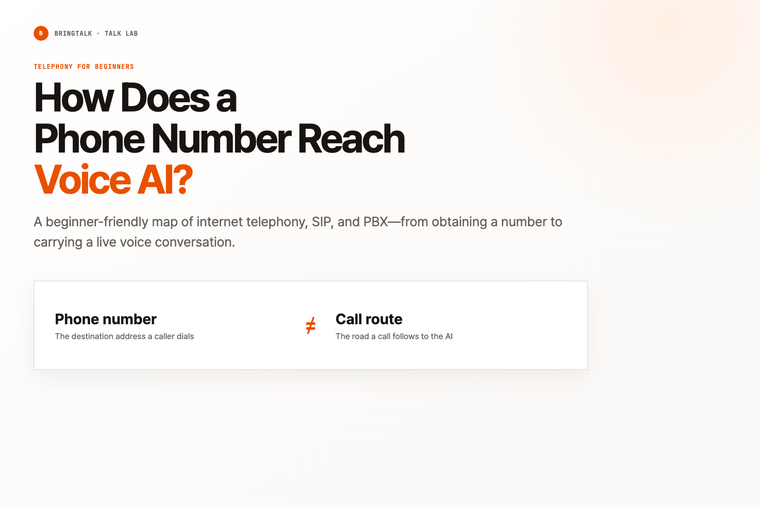
The idea behind this entire guide: a number is an address; the line and protocols form the road the call travels.
One call crosses two different worlds
A call must cross two worlds before it reaches a voice AI.
The first is the public telephone network. It connects mobile and fixed-line networks so that subscribers can call one another. It is commonly called the PSTN (Public Switched Telephone Network, the shared network used for ordinary phone calls). When you dial a number, the originating network finds the network responsible for that number and hands the call across carrier interconnections. The originating and receiving networks are peers. In each call, one sends and the other receives.
The second world is the internet application layer. Internet phones, company switchboards, contact-center software, and voice AI all live here. They use internet addresses and communication protocols instead of a copper phone line.
The border between these worlds is the key point. Where should a call from the public network be sent on the internet? How will the receiving server prove its identity? Which audio format will both sides use? A phone number reaches a voice AI only after those questions have compatible answers.
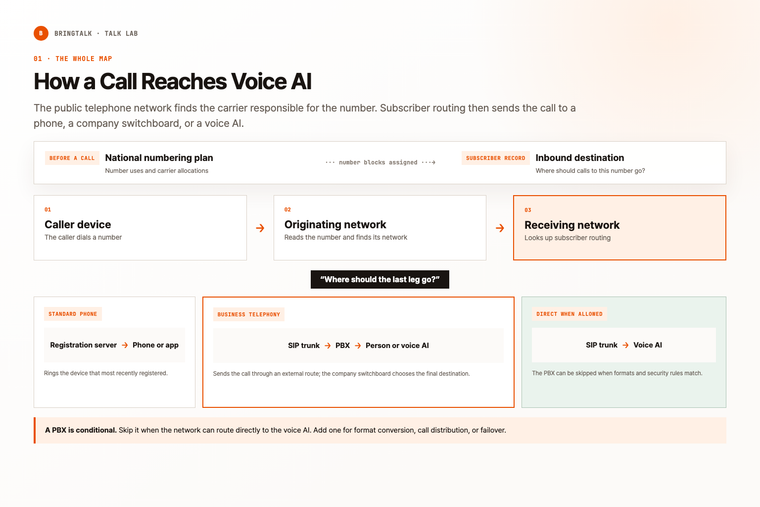
The telephone network uses the number to find the entrance. The company system decides who or what receives the call after it arrives.
A phone number lives in the network ledger, not inside a phone
A phone number is not an object stored in one physical handset. It is closer to a destination entry in a network ledger.
ITU-T Recommendation E.164 defines the basic structure of international telephone numbers. Each country operates its own numbering plan within that framework. In Korea, prefixes such as 010, 02, and 070 distinguish uses and service types. The Korean numbering rules classify 070 as an internet telephone identifier in the Telecommunications Number Management Rules.
When someone dials a number, the network roughly follows this sequence:
- Interpret the country and service type represented by the number.
- Find the receiving network responsible for that number block.
- Hand the call to an interconnection point between networks.
- Let the receiving network check its subscriber record and choose the final destination.
That destination can be a handset, a company switchboard, or an external server. This is also where voice AI compatibility is decided. The provider that controls the number must offer a product and technical interface that can route the call to an external system.
Network operators, connection providers, and developer platforms
The market is easier to understand if you imagine a supermarket. A government defines the barcode system. A telephone network operator runs the warehouse and delivery network. A connection provider packages the goods so they are easier to order and operate. A developer platform supplies the tools that turn the delivered ingredients into a finished service.
A national regulator manages how numbers may be used and assigned. Telephone network operators receive number blocks, interconnect with other networks, and operate the path used to make and receive calls.
A connection provider can bundle number applications, identity checks, external server routing, usage billing, and support into one service. It usually does not invent national numbers. It packages numbers and call capacity obtained from an upstream network operator.
A developer platform handles functions such as speech recognition, dialog logic, speech generation, and connections to booking or customer systems. If it does not operate a telephone network, the phone number and call route must come from somewhere else.
Company names can make the market look complicated. The roles are simpler: one party supplies the number and public network, one connects the internet leg, and one processes the call after it arrives.
Number, line, channel, and trunk are different
A hotel provides a useful analogy. The phone number is the hotel's public address. A line is the contract that lets the hotel use phone service. A channel is one front desk that can serve one guest at a time. A trunk is the main entrance carrying multiple calls into the hotel's phone room.
| Term | Plain-language meaning | What it determines |
|---|---|---|
| Phone number | The address people dial | Which number can make or receive calls |
| Line | A contract unit for phone service | How access and billing are packaged |
| Channel | One slot for a live call | How many calls can run at the same time |
| SIP trunk | An internet route carrying one or more calls | How the network connects to the company system |
The important point is that the number of phone numbers and the number of simultaneous calls do not have to match.
One main number with three channels can handle three calls at once. Ten numbers with only one channel can handle just one live call at a time. This is why the phrase “ten lines” on a quotation is ambiguous. It might mean ten numbers, ten concurrent call slots, or a bundled product containing both.
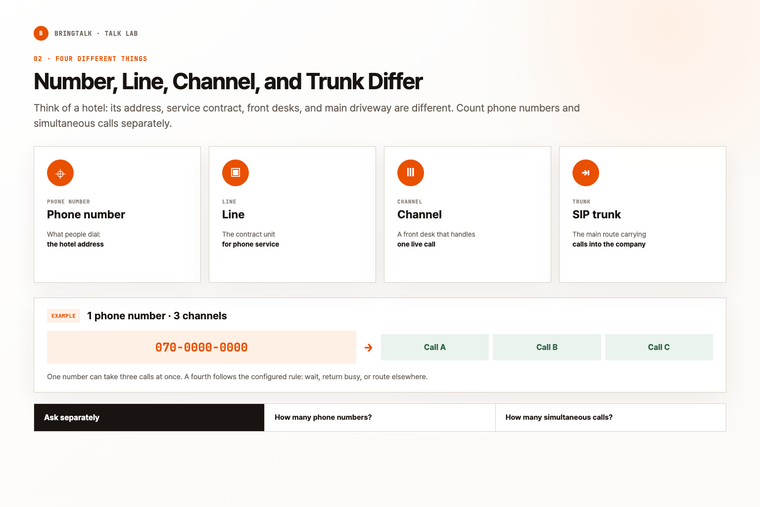
A single main number can have several channels. Ask separately about number count and simultaneous call capacity.
SIP opens and closes the call
SIP (Session Initiation Protocol) acts like an invitation for an internet call. RFC 3261, the core SIP standard, defines how a caller invites a destination, how that destination rings and accepts, and how either side ends the session.
A simplified setup looks like this:
INVITE      Please accept this call
100 Trying  The request is being processed
180 Ringing The destination is ringing
200 OK      The destination accepted the call
ACK         The caller confirms the acceptance
BYE         End the call
The invitation contains more than phone numbers. It also describes where each side should receive audio and which media formats it can use. SDP (Session Description Protocol, the format used to describe media conditions) carries this information. Its rules are defined in RFC 4566.
A product that advertises SIP is not automatically open to an external voice AI. Some products allow only an approved handset to sign in. Others deliver calls only to a company server whose public internet address was registered in advance. The protocol name can be the same while the actual service boundary is very different.
A PBX is the company's call desk
A PBX (Private Branch Exchange) decides where an arriving company call should go. It can implement “press 1 for sales, press 2 for support,” send calls to people during business hours, and send them to a voice AI at night.
A PBX does not issue the public phone number and does not create the public telephone network. In a delivery analogy, it is the reception desk on the ground floor. The courier must first deliver the parcel to the building. Only then can reception choose the correct office.
A PBX is not always required.
- If the network provider can route directly to the voice AI's internet endpoint and both sides use compatible rules, the call can connect without a PBX.
- If the provider accepts only a fixed public internet address, or if signaling and audio formats must be translated, an intermediate PBX may be needed.
- If many numbers must be distributed among several AIs and human teams, or if calls need a backup destination during an outage, a PBX makes the routing easier to control.
A direct connection has fewer components, which can reduce delay and operational failure points. An intermediate PBX gives the company more control over routing and logs, but someone must maintain the server, security rules, monitoring, and recovery. A managed connection service charges a recurring fee because it takes on that operational responsibility.
Signaling and the actual voice are different data
A phone can ring and connect while neither side hears audio. That sounds strange until you separate call signaling from voice transport.
SIP is the invitation. RTP (Real-time Transport Protocol, the rules for transporting small real-time media packets) is the delivery vehicle carrying the voice. RFC 3550 defines how each media packet carries a sequence number and timing information so the receiver can play audio in order.
Business data outside the phone conversation usually travels over HTTPS (the encrypted web protocol). Booking results, customer records, transcripts, and call summaries belong to this third data flow.
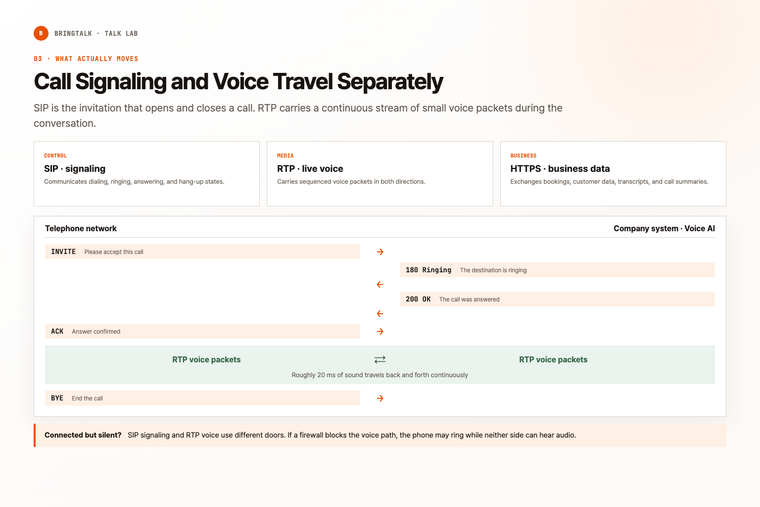
A successful SIP connection means the meeting-room door opened. The separate RTP path must also remain open for voices to pass through it.
Telephone keypad input needs its own check. The two-tone sound produced when someone presses “0 for an agent” is called DTMF (Dual-Tone Multi-Frequency, a way to represent each key with two frequencies). Internet telephony can carry these keys inside audio or as separate events. RFC 4733 defines a common event-based method.
What happens during the live conversation?
When a person speaks, the phone converts the sound into digital data. A codec (a method for encoding and decoding audio) compresses the sound into a known format. The two sides need at least one codec they both understand.
The network splits the audio into small packets and sends them to the voice AI. The following cycle then repeats in a fraction of a second:
- Speech recognition converts sound into text.
- The dialog system decides whether the caller has finished speaking.
- A language model decides what to say.
- Speech synthesis turns the response back into sound.
- New audio packets travel in the opposite direction.
Small delays add up. If several stages each add 0.2 seconds, the response quickly starts to feel sluggish. “Does the call connect?” and “Does the conversation feel natural?” are therefore different tests. The first is about routes and compatible protocols. The second also includes speech-processing speed and turn-taking decisions.
Why a connected call can still be silent
The most common cause is a firewall. A firewall works like a security desk that allows only approved internet traffic through. The door used by SIP signaling can be open while the range of doors used by RTP audio remains closed. The phone then appears connected, but the voice packets never arrive.
NAT (Network Address Translation, a technique that lets several private devices share one public internet address) can cause a similar problem. An apartment number works inside a complex, while a courier needs the building's public street address. If the call invitation advertises a private internal address, the other side cannot find where to send the returning audio.
Incompatible codecs can also produce silence or a failed call. It is like one side speaking only Korean while the other understands only French. The setup messages may succeed even though the two sides never agree on a usable voice format.
Test three things separately: whether the call connects, whether audio works in both directions, and whether keypad input arrives. A test that confirms only one-way audio is only half a success.
What to ask an internet telephony provider
“Do you support SIP?” is too broad. One salesperson may mean SIP login for a desk phone. Another may mean a SIP trunk that delivers calls to a company server.
Ask these questions together to determine whether a connection is actually possible:
- Can inbound calls be delivered to an external server at a fixed public internet address?
- Can the number of phone numbers and simultaneous channels be configured separately?
- Which addresses, ports, and transport methods carry signaling and voice?
- Which codecs and keypad-delivery methods are supported?
- Is the connecting system authenticated by a fixed address, username and password, or certificate?
- Which numbers may be shown as caller ID on outbound calls?
- Can calls fail over to a second server if the first one is unavailable?
If the service will connect calls for customer companies, verify the contract scope as well. Using your own company number and supplying numbers or call capacity to third parties are different commercial and regulatory activities. A technically possible route does not automatically grant permission to resell or provide the service to another company.
The whole map in five statements
A phone number is an address. Obtaining it does not automatically create a route to an external server.
The public telephone network connects the caller to the operator responsible for the destination number. On the internet leg, SIP opens and closes the session while RTP carries the live voice.
A PBX is a reception desk that distributes arriving calls among people, departments, and voice AI. It can be omitted when the network can connect directly, but it becomes useful for format conversion, complex routing, and failover.
The number of phone numbers and the number of simultaneous channels are separate. A quotation should state both.
Finally, connection and conversation quality are different. Test signaling, two-way audio, keypad delivery, and end-to-end delay separately before declaring the call path ready.