Cold Calling Is Back — Here's What Changed
Cold-call answer rates collapse over caller-ID reputation, not the script. What AI actually changes is number rotation, not call volume.

The moment one outbound number gets flagged by a carrier's spam filter, the answer rate on every call from that number collapses together. Cold calling is back in the conversation not because more of it is happening, but because the way people avoid that collapse has changed.
Cold calling is defined by how the contact was acquired, not by the relationship
If telemarketing is defined by what's being solicited, cold calling is defined by how the contact was obtained: a first call to someone with no prior relationship or consent. The two overlap most of the time, but they aren't identical — a first call inviting a job candidate to an interview is a cold call, but it isn't telemarketing, since nothing is being sold.
The practical trap — caller-ID trust breaks before the script does
In cold calling, the first thing to fail isn't the script, it's the number itself. Dial the same number to enough recipients in a short window and carrier or handset spam filters mark it as risky — after that, no script quality matters, because the recipient never answers past the warning label on their screen. Once a number gets flagged, there's little way back short of switching numbers. The most common mistake is optimizing purely for call volume while never designing number-reputation management as its own problem.
The patterns that usually get missed:
- Dialing the same number across many regions or carriers in a short window looks statistically similar to what spam filters are trained to catch.
- Repeated very-short calls (answered and immediately dropped) read to a filter as mass unanswered dialing.
- Sticking to a single number lets flags accumulate — every complaint only erodes that one number's trust further.
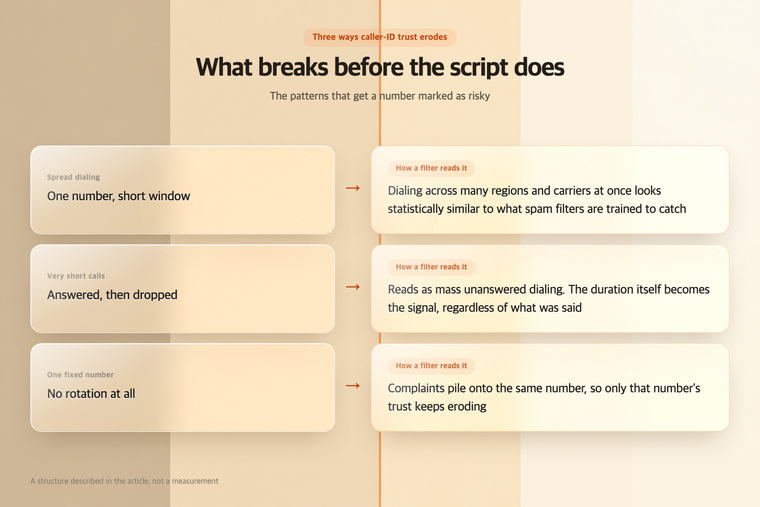
None of the three has anything to do with the script. What gets judged is how the call was placed, not what was said — so rewriting the script leaves all three intact.
What AI actually touches isn't volume, it's number rotation
The value AI outbound adds to cold calling isn't call volume. It's self-adjusting the calling pattern — interval, concurrency, call duration — before a number earns a risk flag, and rotating across multiple outbound numbers so complaints never concentrate on one. Doing this by hand would mean checking, hour by hour, how many calls just went out on which number — a check that falls apart the moment volume picks up. That precision is a place automation genuinely beats people.
Where it still doesn't work
Rotating numbers and pacing calls is a way to dodge spam filters — not a way to make cold calling land only on people who want it. If a recipient is already negative on the company or product, a clean number doesn't raise the answer rate. And if the cold call is a commercial solicitation, prior-consent and opt-out rules apply exactly as before, independent of number management.
Cold calling only performs when the conditions before the dial are right, not the dial itself — a case we already made in when outbound voice AI outperforms inbound.
The line that matters: cold calls stop landing because of number reputation, not the script. Polishing the script while ignoring reputation fixes things in the wrong order.