Five Line Items That Move an AI Contact Center Quote
Same requirements, quotes more than two times apart. Call minutes, average handle time, model tier, integration scope, and the human path — broken down against published vendor rates.


Three quotes came back.
You sent the same requirements document to all three, and the totals are more than two times apart. The instinct is to ask which vendor padded the number. In practice the gap almost always opens in the same handful of places, because AI contact center cost is not a single line you can compare — it is a function sitting on top of a few assumptions.
This piece breaks down the five assumptions that move a quote the most. It is not a price list. Every figure below is a vendor's published rate, with the source and the date it was checked stated in the sentence.
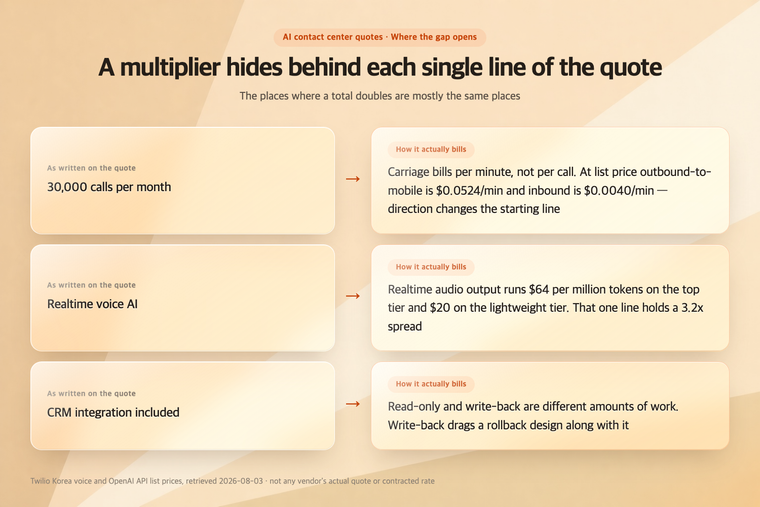
All figures are vendors' published list prices retrieved 2026-08-03, not any vendor's actual quote or contracted rate.
1. You Are Billed in Minutes, Not Calls
Most cost models start with monthly call volume. Telecom billing does not. It runs on minutes, and that mismatch produces the first error.
Twilio's published Korea voice rates, checked on August 3, 2026, make the structure clear.
Twilio Korea voice — published list price (checked 2026-08-03)

  Outbound · landline    $0.0552 / min
  Outbound · mobile      $0.0524 / min
  Inbound                $0.0040 / min
  Phone number           from $1.15 / mo
  Call recording         $0.0025 / min  (billed separately)
The striking part is the gap between outbound and inbound. Inbound costs roughly one-thirteenth of outbound per minute. At the same 30,000 calls a month, an organization taking inbound support calls and one running outbound campaigns start from entirely different telecom baselines.
Match the call count but not the channel direction, and you are comparing two different businesses.
2. Thirty Seconds of Average Handle Time
The second variable is average handle time, and it is where a quote shifts most quietly.
Say one quote assumes 2 minutes 30 seconds and another assumes 3 minutes. Thirty seconds sounds trivial. As a ratio it is 20%, and under per-minute billing that 20% lands directly on the invoice.
At 30,000 calls a month that is a 15,000-minute difference. Applying the published mobile outbound rate above, the gap is $786 a month — from the telecom leg alone. Model usage and recording storage generally scale with talk time too, so in a real total that 20% stacks across several lines at once.
- One: the calculation above plugs in published list prices as-is. It has no relationship to any specific supplier's actual quote or contracted rate
- Two: so average handle time should be an agreed assumption, not a forecast. Pull the measured value from your current interaction logs and hold both quotes to it
3. One Model Tier Is Worth Three Times
Third is the voice model tier. A quote usually reduces this to a single line reading "realtime voice AI." There is a factor of three inside that line.
OpenAI's published API pricing, checked on August 3, 2026:
| Item | Higher tier | Lighter tier | Multiple |
|---|---|---|---|
| Realtime audio input (1M tokens) | gpt-realtime $32 | gpt-realtime-mini $10 | 3.2× |
| Realtime audio output (1M tokens) | gpt-realtime $64 | gpt-realtime-mini $20 | 3.2× |
| Speech recognition (per min) | gpt-4o-transcribe $0.006 | gpt-4o-mini-transcribe $0.003 | 2× |
| Speech synthesis (1M chars) | tts-1-hd $30 | tts-1 $15 | 2× |
Handling the same one-minute call, model cost varies by roughly three times depending on which box you tick. And the choice is not purely financial. On calls with a narrow speech pattern — a booking confirmation, a balance check — the lighter tier is hard to distinguish. On calls with regional accents, background noise, or a caller who talks over the agent, recognition failures become visible.
Tiers are therefore better assigned per call type than across the board. If a quote lists model tier as one line, ask which tier is applied to which type of call.
4. Integration Scope Is the Least Visible Line
The fourth variable moves the money the most while staying the vaguest on paper. "CRM integration included" means a different amount of work at every vendor.
Read only, or read and write
Looking up a customer record and reading it back is one thing. Turning the call outcome into a ticket, changing its status, and assigning an owner is another. The first ends with a single query API. The second requires you to design what happens when the write fails. Duplicate tickets and records left in a wrong state come from exactly here.
Who owns the response time
The moment a core-system lookup takes two seconds, the call goes silent for two seconds. There are two ways out: prefetch the data, or fill the wait with speech. Either way, design and testing attach to it. When that line is missing from a quote, the amount comes back later as a change request.
5. How Wide You Leave the Human Path
The fifth item is the cost of what you decided not to automate. It is often the largest number in real operating cost, and it rarely appears in a vendor quote — not because vendors hide it, but because it sits outside their scope.
Three questions decide it. Does someone need to be available for escalation overnight. How many seconds may pass before a stuck call reaches a human. Does the customer have to explain everything again after the handoff.
That last one links straight back to integration scope. If context captured during automation does not travel to the agent's screen, agent handle time goes up even as automation rate goes up.
6. When This Breakdown Does Not Apply
The analysis above assumes a meaningful call volume. In three situations it fits badly.
- Under a few thousand calls a month. Fixed costs for integration, design, and operations dwarf total variable cost. Comparing per-minute rates to the fourth decimal will not reorder the totals. Compare the fixed line items instead
- When the calls are regulated. For financial identity verification or calls carrying medical information, recording retention and audit requirements determine the architecture first. Variable cost optimization comes after
- When the goal is not cost reduction. In outbound sales, calls generate revenue. Optimizing for shorter calls runs against the objective
7. Five Lines to Fix Before You Compare
Pin these five to identical values on both quotes, and whatever difference remains is a real difference.
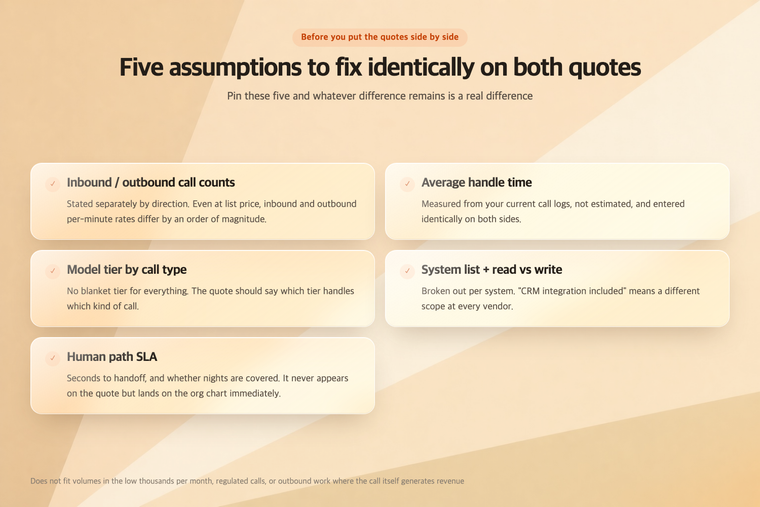
Compare totals without pinning these five and you are comparing two different businesses.
BringTalk starts adoption reviews from these five lines rather than from a total. We pull direction-split volumes and measured handle time out of your existing logs, then segment call types — which is what makes tier assignment and write permissions a matter of numbers instead of preference. Reverse the order and you still get a quote; you just never get an explanation of why it says what it says.
If you want to fill in these five lines against your live interaction logs, we are happy to work through them with you.
Published-rate baseline (checked 2026-08-03): Twilio Korea outbound mobile $0.0524/min, inbound $0.0040/min; OpenAI gpt-realtime audio output $64 per 1M tokens, with the lighter tier at one-third of that. What moves a quote is not these unit rates — it is the five assumptions multiplied against them.