Call Center Outsourcing: How the Cost Structure Works
Comparing seat-based and per-call quotes side by side leaves room for hidden costs. Breaking outsourcing costs into three layers helps you spot what the initial quote doesn't show.

Ask About the Billing Unit Before You Read the Quote
Put two outsourcing quotes side by side and you may be comparing values built on different foundations. One vendor bills a flat monthly rate per seat (agent station); another bills per call or per minute of talk time. Different units, same line — and hidden costs walk in through the gap, usually surfacing after signing when the first invoice runs high.
Three Layers of Cost
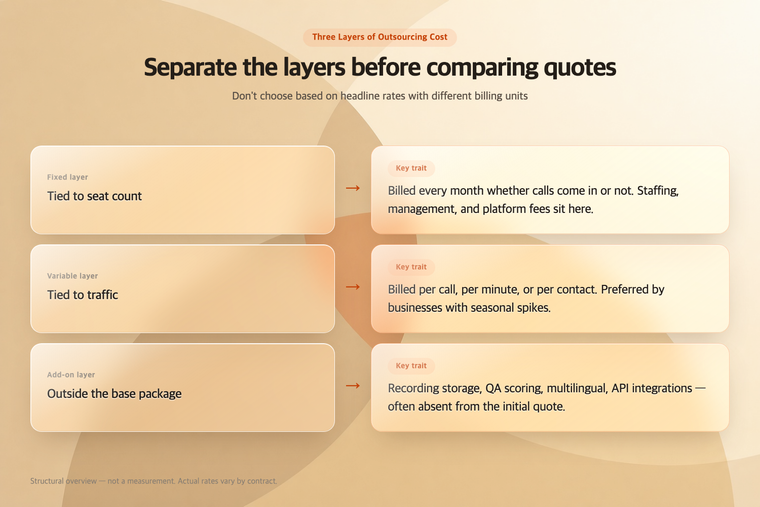
Fixed layer. Money attached to seat count — staffing, management, platform fees. It bills every month whether calls arrive or not, and the count you sign sets the floor.
Variable layer, by contrast, tracks traffic — counted by calls, minutes, or contacts depending on the vendor. It carries less risk under seasonal swings or shaky early forecasts.
Add-on layer — recording storage, QA scoring, multilingual handling, API integrations. Items outside the base package that tend to stay off the quote until just before signing.
The Trap When Seat and Per-Call Billing Mix
Some vendors blend the two: a base seat charge plus per-call billing above a threshold. Model contracted seats against expected volume, or overage cancels out the low-looking seat rate.
The other direction hurts as much — contract generously and you pay full fixed cost in slow months. Run projected volume and average handle time through both structures before comparing.
When This Approach Doesn't Work
Two situations spin the frame. One is a fully bundled flat-fee contract: seats and calls vanish into a single monthly number, so the quote surfaces no layers. Read the inclusion list instead: whether QA scoring sits inside that number, how many months of recordings you get.
The second is very low volume. When monthly calls fall below a vendor's minimum seat unit, some decline to quote; others open with their minimum commitment. Decide whether those calls belong outside your walls before asking which structure is cheaper.
Two Contract Terms to Verify Before Signing
- Minimum volume guarantee — a floor that keeps billing high when traffic falls short, landing on the first month below forecast. Check whether it exists and how far it sits from your estimate.
- Seat adjustment terms. Whether seats scale down as well as up, and what the minimum commitment period is. Some contracts lock the count once you raise it.
Setting a Comparison Baseline
Like-for-like quotes need your own numbers first: average monthly volume, average handle time, seasonal variation, and whether you need QA scoring or recording retention. Those four let you ask on identical terms and expose the lines each vendor left out.
Sequence matters too. The layers become negotiable only after you settle which calls go out, where the quality bar sits, and how a vendor connects to your systems — a stage laid out in What to Check Before Outsourcing Your Call Center.
Convert each quote to a total cost at your projected volume.