Where Tax Advisory Call Automation Should Stop
Korea's public tax helpline data shows 93.5% of consultations arrive by phone. The category most welded to the phone is not the hard tax law question but the easiest-looking one: how to use the filing portal. Here is a three-tier model that draws the line by consequence, not difficulty.

Anyone who has staffed a tax helpline knows January and May are the hard months. What most teams carry is a rough feeling about it, not a figure.
The figure exists. Korea's National Tax Service publishes consultation volumes for its national tax helpline through the public data portal (as of 31 December 2024). Across 2024 the centre handled 4,086,982 consultations. January took 14.5% of the year, May 13.4%. The quietest month, September, took 5.6%.
This piece works through where the automation line should sit. The short version: it does not fall where the questions get hard.
1. The Peaks Are Already on the Calendar
Demand for tax advice is not a hard forecasting problem. Two statutory deadlines — year-end settlement and the May income tax filing — convert directly into call volume.
NTS helpline, share of annual consultations (2024, base 4,086,982)

  Jan   14.5%   year-end settlement
  May   13.4%   income tax filing
  Sep    5.6%   annual low

  peak month / trough month ≈ 2.6x
The same team absorbs 2.6 times more in one month than another. Staff to the trough and calls back up in filing season; staff to the peak and people idle for ten months. The swing arrives with notice — filing dates are published in January — so what runs short is absorption, not foresight.
2. Almost All of It Arrives by Phone
An online consultation channel has been open for years, and the split has barely moved.
| Channel | Volume | Share |
|---|---|---|
| Phone | 3,819,842 | 93.5% |
| Online | 267,140 | 6.5% |
| Total | 4,086,982 | 100% |
More than nine in ten come by phone. The usual reading is that callers dislike digital channels; the next section does not support it.
One qualification matters. The 93.5% counts only what reached the helpline, so it does not prove a preference for phones. It shows something narrower and more useful — the questions that survive self-service end up on a phone line.
3. The Questions More Tied to the Phone Are the How-To Ones, Not the Legal Ones
The same dataset splits consultations into two subject areas: tax law, and use of the Hometax filing portal.
| Subject | Phone | Online | Total |
|---|---|---|---|
| Tax law | 1,525,633 | 173,941 | 1,699,574 |
| Hometax (portal use) | 2,294,209 | 93,199 | 2,387,408 |
By overall share, portal questions take 58.4% and tax law 41.6%. The telling figure is the phone share inside each subject: computed from the volumes above, tax law is 89.8% phone, portal use 96.1%.
Questions about which button to click are more phone-bound than questions about what the law says.
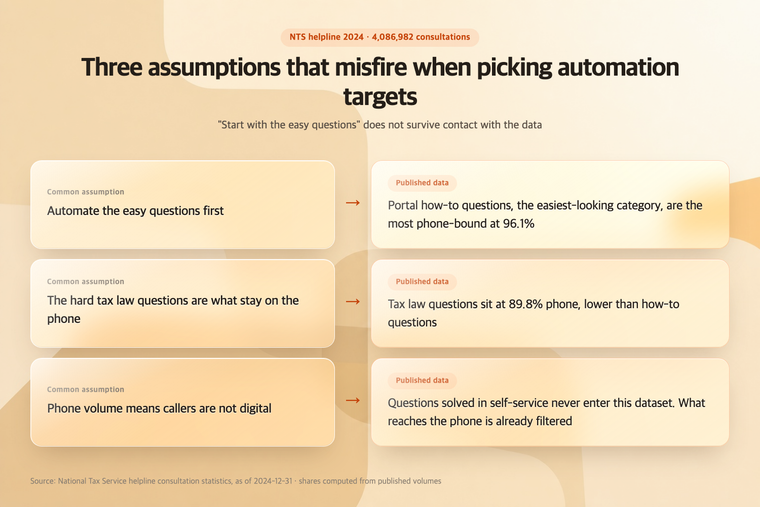
Where the "automate the easy questions first" instinct parts company with the published data. Shares are computed from the National Tax Service's published volumes, not from our own measurements.
That inverts the usual instinct. Teams picking automation candidates start with the easy questions, and the easy category is the one most welded to the phone. The dataset does not explain why, so we will not assert a cause.
4. Draw the Line by Weight of Consequence
Ranking by difficulty walks into that trap. The test we use when scoping voice automation is not how hard a question is but who carries the cost when the answer is wrong. Three tiers.
- Guidance — deadlines, required documents, where a screen lives. The answer is fixed in published material and a wrong one is correctable.
- Lookup — filing status, receipt confirmation, processing stage. The answer comes from a system query; reading the result back is the safe boundary.
- Judgment — whether an expense qualifies, whether a taxpayer meets a condition. A wrong answer leaves a financial consequence that is hard to unwind.
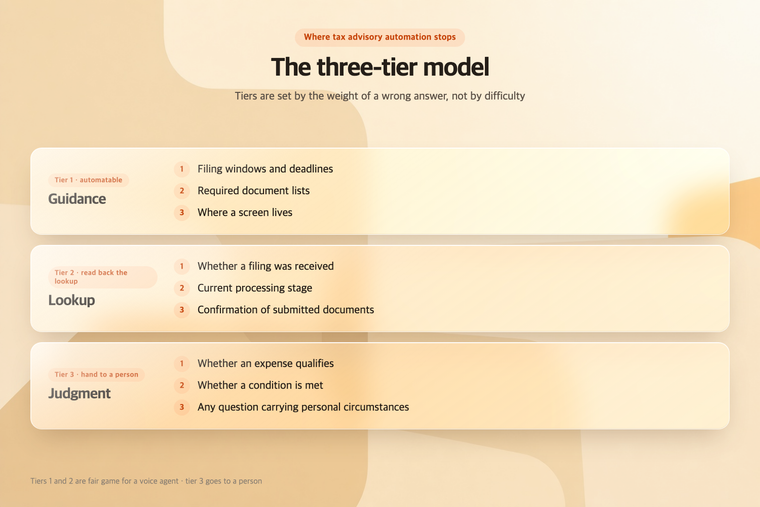
What separates the tiers is not how hard the question is but what a wrong answer leaves behind.
Tiers one and two are fair game for a voice agent. Tier three is not; on an eligibility question the agent's job is to assemble confirmed facts and hand them to a person.
What matters most is the movement between tiers. Calls start in tier one and drift into tier three: someone asking about paperwork adds "but in my case, does that still apply?" Automation that misses that sentence invents a tier-three answer. Classifying the question is hard; noticing when personal circumstances enter it is not.
5. Covering the Peak With People Costs Twice
Filing season is usually met with temporary staff. Absorbing a 2.6x swing that way runs up cost in two places.
- Training does not finish before the season does. By the time someone can field tax law questions competently, the peak has passed
- The highest-volume questions are the most repetitive. Portal walkthroughs, with fixed answers, consume the time of experienced advisors
Clearing tiers one and two changes what remains. Volume drops while each human-handled call gets harder. That is intended, and performance measures have to move with it: handled counts fall, handle time grows, and both signal the system is working.
6. What to Settle Before the Season Starts
There is an order to this. The sequence we follow on an advisory line runs as follows.
- Pull question types from last season's call logs and sort them into tiers one, two, and three. Sorting from memory means doing it again later
- Write down the phrases that signal a move into tier three. Escalation conditions are set by people, in advance
- Fix a single source document behind every tier-one answer. The moment automation contradicts official guidance, its credibility is gone
- Confirm retention and deletion rules for call records. Tax consultations expose income and family circumstances in plain speech
The fourth is easiest to postpone, which is why we default to an architecture retaining no conversation data. That question cannot be settled once the season has begun.
7. Where This Approach Does Not Hold
Three conditions make the sequence above a poor fit.
First, organisations whose demand does not follow a calendar. The premise here is a 2.6x swing; where the curve is flat, fixing scheduling comes before automation.
Second, cases where tier-one answers change often. When rules are revised, guidance wording shifts mid-season and tier one stops being a target too.
Third, organisations without call logs. Sorting question types from recollection locks the scope out of step with actual traffic. Memory keeps the striking calls; logs keep the tedious ones, and the tedious ones are what should be automated.
One caveat. These figures come from a single public helpline; accounting firms and licensed tax agents field a different mix. What the dataset shows sits above any one organisation: tax advisory work is bound to a calendar and a phone line at once.
Key figures: 4,086,982 consultations in 2024, 93.5% by phone · peak month (January, 14.5%) against trough (September, 5.6%) ≈ 2.6x · portal questions 96.1% phone against tax law 89.8%. Source: National Tax Service helpline consultation statistics (as of 31 December 2024, Korea public data portal); the 96.1%, 89.8% and 2.6x are computed from the published volumes.