Voice AI Fraud Defense Gate: Identity, Consent, and Audit Evidence in the Age of Voice Cloning
Voice cloning and vishing risks require a Voice AI operating gate that connects caller signal, consent, risk score, step-up verification, and audit receipts before automation.


As voice agents become more natural, enterprises have to answer a harder question before automation: “Is this really the customer?” In 2024, the FCC clarified that AI-generated voices can qualify as “artificial voice” under the TCPA for robocalls, and the FTC’s Voice Cloning Challenge highlighted detection, watermarking, and authentication as core defenses. Voice AI security is no longer only about the model. It is about the operating gate that links caller identity, consent, risk scoring, escalation, and audit evidence.
Why Voice Fraud Belongs in the Voice AI Roadmap
The phone channel has always depended on trust. Many service flows still rely on phone number, tone of voice, partial personal information, and conversational confidence. Synthetic voice weakens that assumption.
The FCC’s February 8, 2024 announcement made AI-generated robocall voices a regulatory issue, not just a technical novelty. The FTC’s April 2024 Voice Cloning Challenge pointed to a practical defense stack: AI-generated voice detection, watermarking, and authentication.
AI voice is a customer-experience interface and a fraud input channel at the same time.
That means deployment teams should not start with containment rate alone. They need to define which calls can be trusted, which requests require step-up verification, and which scenarios must go to a human.
The First Security Boundary Is the Call Entrance
Many security reviews begin with LLM prompts, data retention, and API permissions. Those are necessary, but voice fraud starts before the model responds. An attacker can sound like a customer, create urgency, and pressure the flow before the agent reaches any tool call.
The first boundary should therefore be: “How should this call be risk-rated?” not “What is the model allowed to say?”
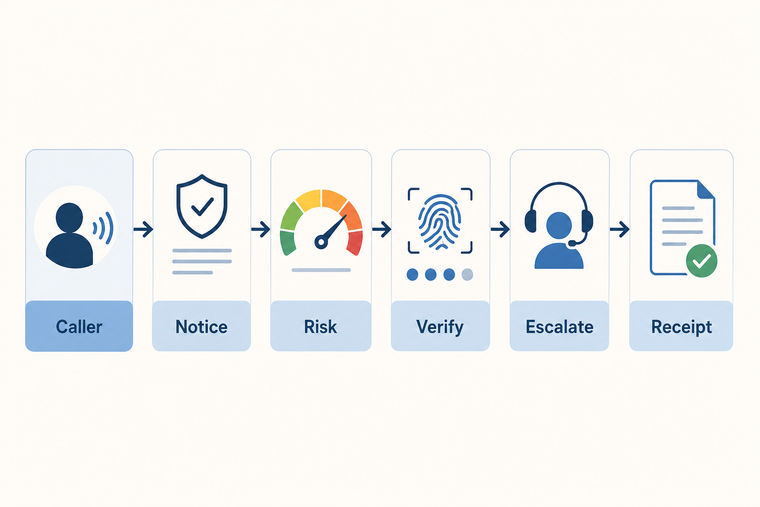
Inbound call
→ channel / caller / context signal
→ consent + purpose notice
→ risk score
→ allowed automation scope
→ step-up verification or human escalation
→ audit receipt
This is not bureaucracy for its own sake. It separates calls the agent can safely automate from calls where the enterprise must preserve human accountability.
A Five-Step Fraud Defense Gate
1. Caller Signal: Do Not Trust Phone Number Alone
A caller ID match is useful, but it is not identity proof. The agent should combine CRM match, recent journey data, callback source, campaign context, and previous contact history. A matched number can still trigger step-up verification if the request is high-risk. An unmatched number can still receive low-risk information if the automation scope is constrained.
2. Consent and Purpose: Record the Notice as an Event
A single “this is an AI agent” sentence is not enough. Teams should record the purpose of the call, the notice version, the customer’s continuation, and the data boundary. In a dispute, the question becomes not “did we disclose?” but “which disclosure was accepted, when, for what purpose?”
3. Risk Score: Treat Intents Differently
Checking delivery status and changing a refund account are not the same action. Confirming an appointment and initiating an insurance claim are not the same risk. Voice AI needs intent-level automation limits.
- Low risk: opening hours, appointment availability, campaign information
- Medium risk: callback booking, partial profile update, complaint intake
- High risk: payment, refund, bank account, identity verification, legal consent, contract change
4. Step-Up Verification: Escalate the Proof, Not the Friction
When risk increases, the agent should not silently continue. It can move to SMS link, app push, additional verification, human transfer, or post-call review. The goal is not to block every uncertain call. The goal is to stop the agent from pretending certainty when the evidence is weak.
5. Audit Receipt: Make the Decision Reproducible
NIST’s AI Risk Management Framework and Generative AI Profile emphasize identifying, measuring, and managing AI risks. In Voice AI, that principle has to land at the call level.
A useful call record should include at least:
call_id
consent_notice_version
customer_intent
risk_score_bucket
automation_scope
step_up_reason
handoff_target
disposition
Without this receipt, security, operations, and sales teams will reconstruct the same incident with different assumptions.
BringTalk POV: Zero Retention Is Necessary, Not Sufficient
Zero Retention is an important boundary: personally identifiable information should not remain on external LLM servers. But voice fraud defense cannot be solved by retention policy alone. The operating layer must decide who is calling, what the request is, and how far automation is allowed to proceed.
In BringTalk deployments, Context Injection is not only a personalization feature. It is also risk evidence. CRM history, campaign source, recent service records, and customer-initiated callback data help the system become not just a more helpful agent, but an agent that knows when to stop.
Deployment Checklist
Before launching a Voice AI workflow, align on six decisions:
- Which intents are high-risk?
- Which AI notice and consent version will be recorded?
- Where does identity verification become stronger?
- Is human handoff triggered by intent, risk score, or both?
- Who reviews suspected impersonation calls?
- Where is the call-level audit receipt stored, and who can read it?
If these answers are missing, improving automation rate can turn a customer-experience project into an operational risk.
Public Sources Reviewed
- FCC, “FCC Makes AI-Generated Voices in Robocalls Illegal,” February 8, 2024.
- FTC, “FTC Announces Winners of Voice Cloning Challenge,” April 8, 2024.
- NIST, “AI Risk Management Framework” and “Generative AI Profile,” 2024 update.
- CISA, “Avoiding Social Engineering and Phishing Attacks,” vishing guidance.
The security benchmark for Voice AI is not how human it sounds. It is whether the system stops, escalates, and leaves evidence at the right moment.