Public-Sector Voice AI Needs Governance Gates Before Pilots
A public-sector voice AI pilot should start with access, scope, consent, evidence, and review gates—not with automation targets alone.


When voice AI enters public services, the core question is not “Can this be automated?” It is “Can this be operated with accountability?” In June 2026, ElevenLabs announced an MoU with the UK Department for Science, Innovation and Technology to explore voice AI for public-service access, moving voice agents from private contact-center optimization into public-interface infrastructure.
Public Voice AI Is Not a Standard Call Center
Public-service calls carry a different obligation from commercial support. The caller is not just a customer comparing products. They may be trying to access rights, benefits, safety guidance, or administrative procedures.
On June 8, 2026, ElevenLabs said it had signed a Memorandum of Understanding with the UK DSIT to find ways to use voice AI to improve public services. The same announcement also referenced AI security collaboration and investment in the UK as a voice and audio AI talent hub.
The real advantage of public-sector voice AI is not higher containment. It is an operating boundary that citizens can understand, challenge, and reverse.
Five Gates Should Come Before the Pilot
For public-sector voice AI, the first artifact should not be a feature list. It should be a deployment gate. These five gates are approval criteria, not just implementation notes.
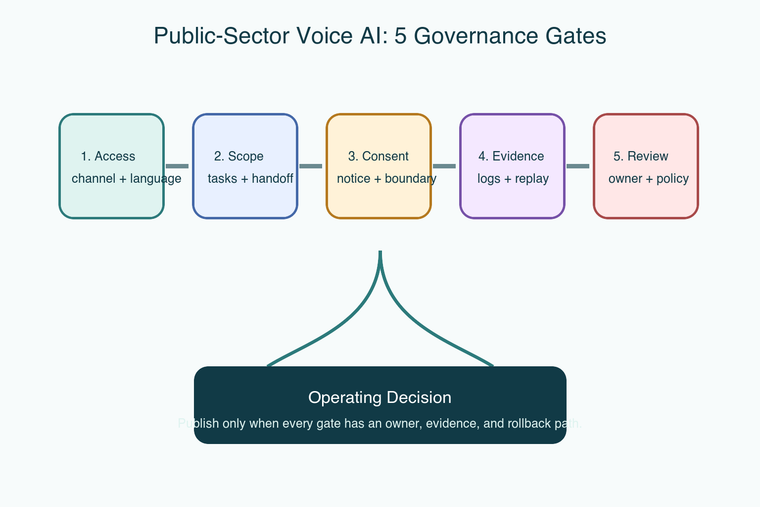
- Access — define the citizen channels, languages, and accessibility needs the agent will support.
- Scope — separate tasks the AI may finish from cases that must move to a human.
- Consent — disclose recording, purpose, retention boundaries, and external model use at the beginning of the call.
- Evidence — keep replayable evidence, not just a summary: policy version, prompt version, inputs, and system actions.
- Review — name the human owner for policy changes, complaints, failures, and rollback.
The EU AI Act Normalizes Risk-Based Operations
The European Commission describes the AI Act as the first comprehensive legal framework for AI and explains that obligations differ by the risk of specific AI uses. That does not mean every public voice agent receives the same legal classification, but it does mean buyers are learning to evaluate AI through risk-based operating controls.
A proposal should therefore prove operational readiness before model sophistication.
Public-sector voice AI readiness
- Citizen notice: present before collection
- Human escalation: available for rights / safety / exception cases
- Decision evidence: replayable from call event to system action
- Data boundary: retention and external processor scope documented
- Policy owner: accountable team named before launch
Accessibility Is an Operating Responsibility
Voice AI can create a new access path for citizens who struggle with digital portals. But if accessibility becomes an excuse for aggressive automation, vulnerable users may be pushed into the least transparent channel.
Public voice AI should be easy to start, easy to leave, and explainable after the fact. In benefits, healthcare, education, tax, or immigration workflows, the handoff condition often matters more than the answer itself.
BringTalk POV: Evidence Beats “Better Support”
This is why BringTalk does not frame enterprise voice AI only as LQA or FUA. Lead qualification, appointment booking, and follow-up automation all scale only when they sit inside an approval line and evidence system.
For public-sector or regulated deployments, Context Injection is not just personalization. It is the operating mechanism that records why the agent gave a response. Zero Retention is not a slogan either; it is a buying-risk language that clarifies what does not remain on external model servers.
Pilot Success Metrics Need a Rewrite
Average handling time is not enough for a public-sector pilot. The operating review should ask harder questions first.
- When did the citizen learn they were speaking with AI?
- Which exceptions moved from AI to a human, and by what rule?
- If a complaint arrives, can the call and decision path be replayed?
- When policy changes, which prompt, scenario, and knowledge-base assets change with it?
- If the agent fails, who can pause or roll back the service?
Public-sector voice AI should be measured less by “how many agents it replaces” and more by whether it turns a citizen interface into an accountable operating system.