The Voice AI Implementation Partner Era Is Here
The TELUS Digital × ElevenLabs partnership signals a shift from buying voice platforms to operating production-ready Voice AI across CRM, telephony, governance, and frontline escalation.


The signal in the Voice AI market is changing. On June 22, 2026, TELUS Digital and ElevenLabs announced a partnership to bring ElevenAgents into enterprise customer-experience operations. The important part is not simply that the model is better. It is that a named operator is stepping forward to connect platform, CRM, telephony, governance, and frontline operations into production.
The Real Signal Is Operations, Not Another Model
According to the Nasdaq/PRNewswire announcement, TELUS Digital becomes a preferred implementation partner for ElevenLabs’ AI voice agent platform, ElevenAgents. The release says ElevenAgents handle high-volume routine interactions and route complex or sensitive cases to human frontline teams.
The key phrase is not “voice AI platform.” It is “implementation, integration and governance.”
For buyers, the question shifts. Instead of asking only “which model does it use?”, enterprises now need to ask: “Who owns CRM integration, telephony, monitoring, escalation, and change management after launch?”
Voice AI Is No Longer Just an API Purchase
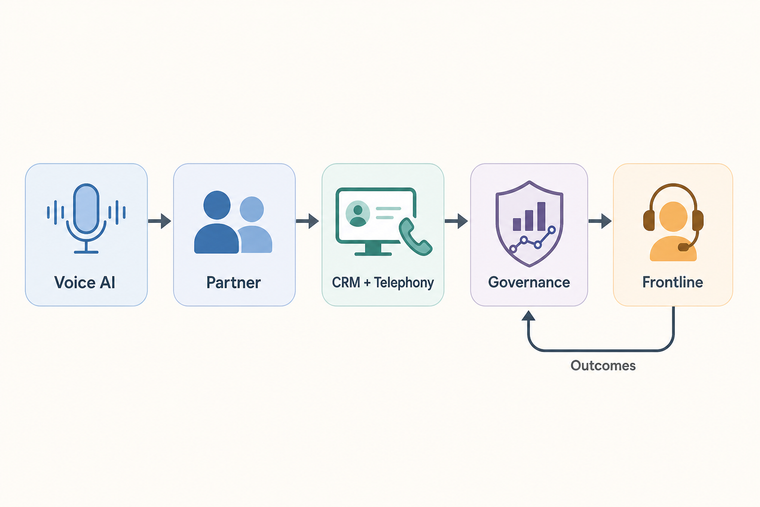
A production voice agent is not a single API call. At minimum, five layers have to work together.
1. Voice AI platform: STT, LLM, TTS, turn-taking
2. CRM/contact center: Salesforce, Zendesk, Genesys, Amazon Connect, and customer records
3. Telephony: SIP, recording, transfer, numbers, and campaigns
4. Governance: monitoring, policy, fallback, and quality review
5. Frontline handoff: agent escalation, exception handling, and learning loop
That is why the TELUS Digital announcement mentions CRM, CX, telephony platforms, orchestration, monitoring, and human capability in the same operating frame. Voice AI projects usually fail not because one model is weak, but because responsibility is unclear between these layers.
The Implementation Partner Becomes the Release Owner
Traditional systems integrators often connect systems and exit after deployment. Voice AI works differently: post-launch operating quality is the product quality. The announcement also states that TELUS Digital’s role continues beyond go-live, including ongoing optimization, training, compliance alignment, and frontline support.
In this structure, the implementation partner has to keep watching four operating questions:
- Which call types should remain automated?
- Which caller patterns require human escalation?
- Does CRM evidence provide enough context for the next interaction?
- Do monitoring results flow back into prompts, routing, and knowledge bases?
In other words, the implementation partner is not just an installer. It becomes an owner of the operating release gate.
What This Means for Korea and APAC Buyers
Korean enterprises can build Voice AI pilots quickly, but production is where customer data, call recording, frontline handoff, and internal approval lines collide. In finance, public-sector, and large contact-center environments, the deciding question is often not “did AI answer?” but “who is accountable for the operating model?”
Five RFP questions matter more than another demo clip:
- Which call types are explicitly excluded from automation?
- What summary and evidence does the human agent receive after handoff?
- How are call outcomes written back to CRM and quality review?
- When a policy or complaint changes, which release gate does the system return to?
- Who detects and fixes operating degradation after launch?
If these questions are unanswered, a voice agent can look good in a demo and still lose adoption in the field.
BringTalk POV: Partner-Led Operations Reduce Buyer Risk
BringTalk’s LQA, FUA, and Context Injection work all point to the same operating reality. The goal is not only to make AI sound natural. The goal is to connect customer journey data, follow-up actions, human escalation, and quality review into one governed loop.
The next Voice AI differentiator is not who sounds most human. It is who designs the safest operating responsibility line for the customer.
The TELUS Digital × ElevenLabs announcement is a market signal: enterprises are starting to treat Voice AI as a production operating system, not a standalone platform purchase. That direction is positive for Voice AX partners like BringTalk. Buyers need fewer demos and more operating models that still work after the demo ends.