
Operable Voice AI: Why Transcripts Are Not Enough
Production Voice AI needs more than transcripts. Event timelines, fallback signals, handoff quality, and LQA/FUA outcomes turn calls into an operating system.


Production Voice AI does not behave like a clean demo. Customers interrupt, CRM fields are missing, external APIs slow down, and human handoff can happen without warning. The core question is no longer “does the agent sound good?” It is “when something breaks, can the team see where, why, and how fast?”
Demo Logs Are Not Operational Observability
A demo log is enough to replay one call. Operational observability has to reveal repeated failure patterns across many calls.
A transcript is an incident record. Observability is an operating system.
Voice AI observability should separate three layers:
- Conversation layer: silence, interruption, repeated questions, failed closing
- System layer: STT, TTS, LLM, API latency, timeout, fallback calls
- Business layer: lead qualification, booking, handoff, follow-up requirement
When these layers are mixed into one view, teams see only the outcome: “the customer was unhappy.” They do not see the root cause.
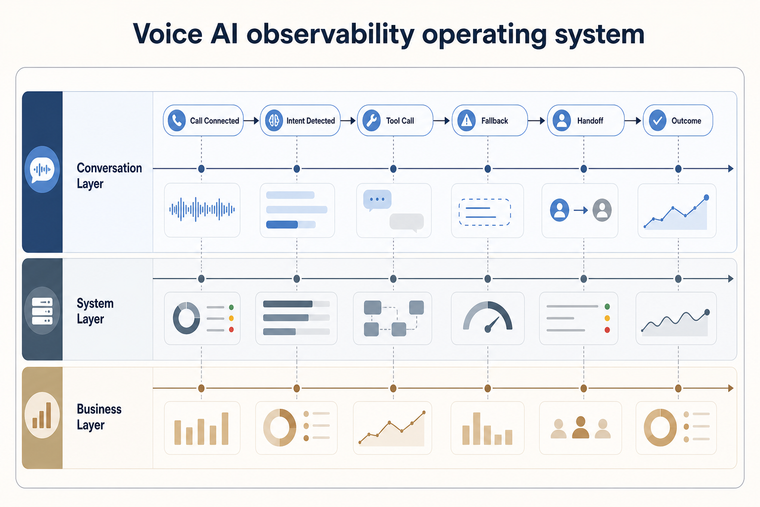
Call Quality Needs an Event Timeline
The most useful debugging unit for Voice AI is not the full transcript. It is the event timeline. Enterprise teams need customer speech, agent response, tool call, CRM write, and human handoff on the same clock.
00:00 inbound call connected
00:08 customer intent detected: pricing_question
00:10 crm_lookup started
00:12 crm_lookup timeout → fallback_lane_2
00:15 agent asks confirmation question
00:31 handoff_requested: high_value_lead
This timeline separates “the model answered poorly” from “the CRM lookup was late.” Those two problems require different fixes.
Five Metrics Are Enough to Start
Teams do not need a large dashboard on day one. From BringTalk’s operating perspective, the daily Voice AI view should start with five signals.
- Completion: Did the call reach the intended action?
- Fallback rate: How often did the agent move to a recovery lane?
- Handoff quality: Was enough context passed to the human team?
- Latency budget: Where did delay occur: STT, LLM, TTS, or tool call?
- Business outcome: Was a lead, booking, payment, or follow-up recorded?
The trend matters more than the absolute number. A single fallback rate is less useful than knowing which fallback increased after a new prompt release.
Zero Retention Makes Log Design More Important
Enterprise customers cannot keep raw calls and personal information indefinitely. In a Zero Retention environment, teams need to preserve operational signals without leaving PII on external LLM servers.
Keep
- Structured events such as intent, outcome, and fallback reason
- Masked tool-call results and error classes
- Handoff reason and agent confidence
Do Not Keep
- Raw PII such as ID numbers, card numbers, account numbers, or detailed addresses
- Sensitive statements copied directly from transcripts
- Internal pricing, margin, or cost structure
Observability is not about storing more data. It is about keeping the right signals safely.
BringTalk’s Standard: Close the Loop Through LQA and FUA
When Voice AI handles leads, observability cannot stop at call quality. LQA determines qualification during the call. FUA triggers the right follow-up after the call.
A closed-loop operating system looks like this:
call event → qualification signal → CRM update → follow-up trigger → outcome review
If this loop breaks, Voice AI remains a tool that processes calls. If it closes, the team can see which segments need better qualification questions and which handoff conditions should become stricter.
The Standard for Operable Voice AI
Strong Voice AI does not promise perfect calls. It classifies failure, recovers from it, and makes the next release better.
- With transcripts only, teams can review calls but struggle to operate them.
- With event timelines, root-cause analysis becomes faster.
- With LQA/FUA outcomes, call quality connects to business improvement.
The standard for production Voice AI is not one successful demo. It is observability that turns failure into the next deployment signal.