Insurance FNOL Voice AI: From First Call to Adjuster Approval Gate
In insurance claims, Voice AI should not decide coverage. It should turn the first call into a reliable evidence bundle for adjusters.


FNOL, or First Notice of Loss, is the first moment a customer reports an incident to an insurer. In that call, Voice AI should not try to “settle the claim”; it should create a clean evidence bundle for the adjuster.
FNOL Needs Routing Before Automation
Insurance callers often contact the company right after an accident, with incomplete information and high stress. If a voice agent starts making coverage or payout statements, the risk rises quickly.
The operating goal is not “AI decides the claim.” It is “AI reduces the adjuster’s first-review time.”
This article is an operating scenario, not a customer case study with deployment metrics. External grounding is limited to verifiable public sources: NAIC consumer auto-insurance guidance, NHTSA’s structured recall API as an example of machine-readable automotive data, and public agent/CRM documentation from platforms such as Vapi and Salesforce Agentforce.
Narrow the Call to Five Intake Fields
FNOL calls become long when the question order drifts. A safer voice-agent design treats AI as an intake layer that reliably captures five fields.
- Identity and policy candidate: name, contact, policy/vehicle hints
- Time and location: date, time window, place and context
- Damage type: vehicle damage, bodily injury, property damage, roadside need
- Risk flags: injury, police report, suspected hit-and-run, escalating damage
- Next action: photo upload, tow or service booking, adjuster callback, CRM/claim-system log
FNOL voice layer = identify → capture facts → flag risk → route → log evidence
Not included      = coverage decision, payout promise, liability judgment
That boundary makes it easier to tell the customer: the report is logged, but the final assessment remains with the insurer.
Separate Intake From the Approval Gate
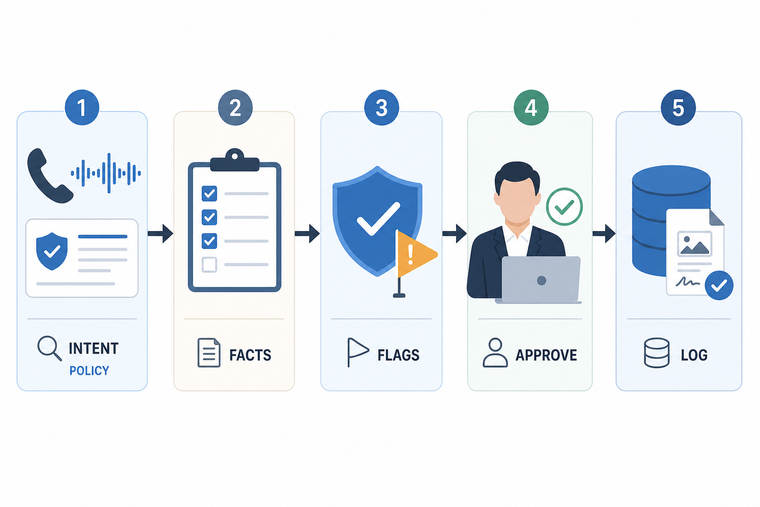
The core design move is to separate what Voice AI can do in real time from what a human must approve.
- AI handles: repeated confirmation, missing-field questions, upload-link guidance, callback windows
- Systems handle: CRM or claim ticket creation, transcript and summary storage, risk-flag tagging
- Humans approve: coverage language, liability-sensitive explanations, payout or denial decisions, sensitive complaints
From a BringTalk perspective, this is where Context Injection matters. The agent should receive customer journey and policy-candidate context at call start, while the architecture keeps unnecessary PII out of external LLM retention paths through a Zero Retention boundary.
Evidence Traceability Beats Fast Answering
The quality of FNOL automation should not be measured only by average handle time. The sharper questions are operational.
- What can the adjuster verify immediately after the call?
- Are the customer’s raw statements stored separately from the AI summary?
- Does each risk flag point back to transcript evidence?
- Does the next action become a CRM or claim-system task?
In insurance and financial services, customers can easily interpret AI wording as an official decision. That means the voice script needs pre-approval language.
Example: “Your report has been recorded. An adjuster will confirm coverage and next steps before any final determination.”
One sentence can reduce the risk of turning intake automation into unauthorized claims guidance.
Start the PoC With Three Call Types
A FNOL Voice AI PoC should not attempt to automate the entire claims journey at once. The first scope should be narrow.
- Simple intake: collect facts, send photo link, schedule callback
- Urgent routing: detect injury, towing, or escalating-risk signals and transfer to a human
- Supplement request: collect missing documents, extra photos, or service appointment confirmation
Each call type needs a different success metric. Simple intake should track missing-field reduction. Urgent routing should track human handoff speed. Supplement requests should track CRM task completion. A single containment rate hides too much operational risk.
BringTalk Design Takeaway
FNOL Voice AI is not an “insurance expert bot.” It is the front door of a claims operating model. BringTalk would lock four controls before scaling it.
- Approval gate: phrases the AI must never state as final
- Evidence log: summary, raw transcript, recording link, and system fields stored separately
- CRM/claim handoff: next actions created as owner-visible tasks
- Security boundary: PII minimization, Zero Retention, role-based access
The goal of FNOL Voice AI is not to automate the claim decision. It is to make the first call reliable enough for the adjuster to continue without redoing intake.