The Finance Voice AI Approval Gate: An Operating Scenario for Regulated Contact Centers
For finance and insurance Voice AI, the first design question is where the agent should stop and ask for human approval.


In financial-services and insurance contact centers, the core Voice AI question is not “how much can we automate?” It is “where should the agent stop and ask a human to approve?” This article uses a composite operating scenario, not a named customer case, to show how regulated teams can design an approval gate before scaling Voice AI.
Why Finance Needs an Approval Gate First
A single financial call can mix simple service requests with sensitive decisions. Office hours, document lists, claim status, and appointment changes can often be automated. Loan-condition changes, insurance payout guidance, account updates, and complaint handling require a control line.
Automation looks efficient when completion rate rises. In regulated contact centers, the safer first metric is whether the AI stops at the right moment.
Two external signals shape this view. The CFPB has warned that banking chatbots can delay issue resolution or prevent customers from getting the support they need when problems are complex. Salesforce’s Agentforce Contact Center announcement points to a market direction where AI agents, CRM, and service channels operate on one customer-service surface. In that model, Voice AI is not a separate replacement channel; it is an operating layer inside CRM and human approval workflows.
Scenario: When an Insurance Claim Call Becomes an Approval Case
Imagine an insurance customer asks, “When will the claim I filed last week be paid?” A Voice AI agent can verify identity and provide confirmed information such as claim status, required documents, and the current processing step.
But the moment the customer asks, “Can you confirm it will be paid?”, “Please change my payout account now,” or “Can this be handled without an advisor?”, the call should become an approval case.
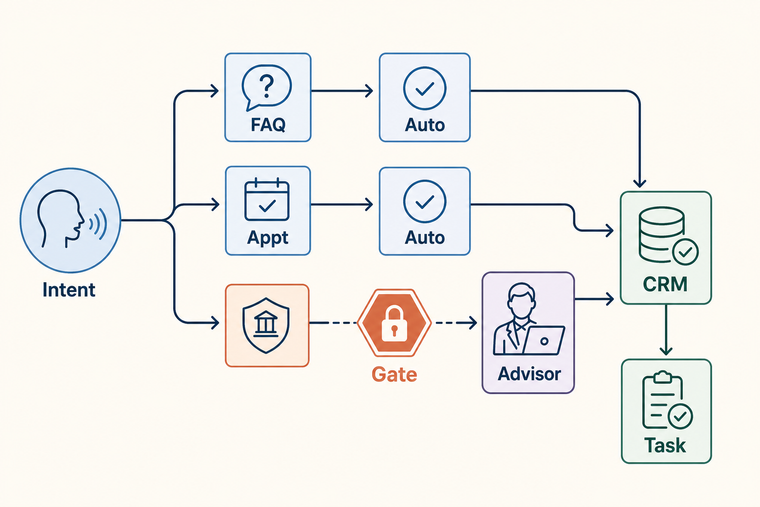
The flow should work like this:
- Classify the utterance as
low-risk,regulated,account-change, orcomplaint. - If the intent is
regulatedor higher, the Voice AI stops short of final judgment and sends the case to a human advisor. - The advisor receives the call summary, source utterance, CRM history, and recommended next action.
- The approval, rejection, or follow-up decision is logged back to CRM with a task for the next call or message.
A Gate Is a Policy, Not Just a Transfer Button
Many pilots add a handoff button and call the risk solved. Finance and insurance need a stronger design. The team must define which intents can be completed automatically, which must pause for approval, and which can be answered but still require a CRM record.
Auto-resolve: hours, document list, claim status, appointment change
Approval required: loan terms, payout likelihood, account/address change, complaint language
Immediate handoff: failed identity check, high-risk complaint, legal dispute signal, vulnerable-customer signal
Record required: customer consent, disclosure text, approving advisor, final outcome
This lets QA evaluate more than answer accuracy. It can test whether the agent stopped at the correct control point.
If It Is Not Logged, It Cannot Be Proven
The final step in an approval gate is not transfer. It is evidence. The system should record why the Voice AI stopped, what the customer said, what the advisor approved, and which follow-up task was created.
- Before advisor review: customer identity, intent, recent history, risk signal
- During review: AI summary, source utterance link, recommended next action
- After review: approver, outcome, disclosure status, follow-up call or message task
With this structure, Voice AI becomes more than a call-deflection tool. It supports internal control and customer experience at the same time.
BringTalk POV: Design the Stop Point Before the Script
For a finance or insurance Voice AI rollout, BringTalk would start with an approval matrix before writing the full conversation script. The team needs to agree on which intents are automated, which are escalated, and which CRM fields prove the decision path.
Deployment Checklist
- Have auto-resolvable intents and approval-required intents been separated?
- Does the advisor summary link back to the source utterance?
- Are disclosure, consent, approval, and outcome recorded in CRM?
- Does QA measure stop-point quality, not only answer accuracy?
- Does the AI avoid definitive language when the customer asks for a sensitive decision?
In finance and insurance Voice AI, quality is not the ability to keep answering. It is the ability to stop, route, and leave evidence when responsibility moves to a human.
Sources
- CFPB, “Issue Spotlight: Chatbots in Banking,” 2023: https://www.consumerfinance.gov/about-us/newsroom/cfpb-issue-spotlight-analyzes-artificial-intelligence-chatbots-in-banking/
- Salesforce, “Agentforce Contact Center” announcement, 2025/2026: https://www.salesforce.com/news/stories/agentforce-contact-center-announcement/