Automotive Recall Appointment Voice AI: From VIN Check to Advisor Handoff
Recall calls need more than booking automation. This operating scenario shows how Voice AI can connect VIN checks, safety guidance, appointment slots, and advisor handoff.


Automotive recall and service appointment calls are not ordinary booking calls. They combine safety communication, VIN eligibility checks, appointment coordination, and service-advisor handoff in one operating flow.
Why Recall Calls Are Different From Normal Bookings
A customer who receives a recall notice usually wants three answers at once: whether their vehicle is affected, whether it is safe to keep driving, and where they can get the remedy done. If one answer is unclear, the customer calls again or repeats the same context to a service advisor.
The U.S. NHTSA Recalls API exposes structured recall fields such as NHTSACampaignNumber, Component, Summary, Consequence, Remedy, and ReportReceivedDate. A 2023 Hyundai Sonata lookup, for example, returns campaign identifiers, defect summaries, risk descriptions, remedy instructions, and owner contact guidance in a machine-readable response.
The goal of recall Voice AI is not to end the call faster. It is to reduce uncertainty and carry the customer into the right service slot.
Demo Scenario: VIN Check → Booking → Handoff
This is an operating scenario, not a public customer case study. In production, the flow should be adapted to each OEM or dealer group’s recall data, appointment inventory, customer-consent policy, and service-advisor workflow.
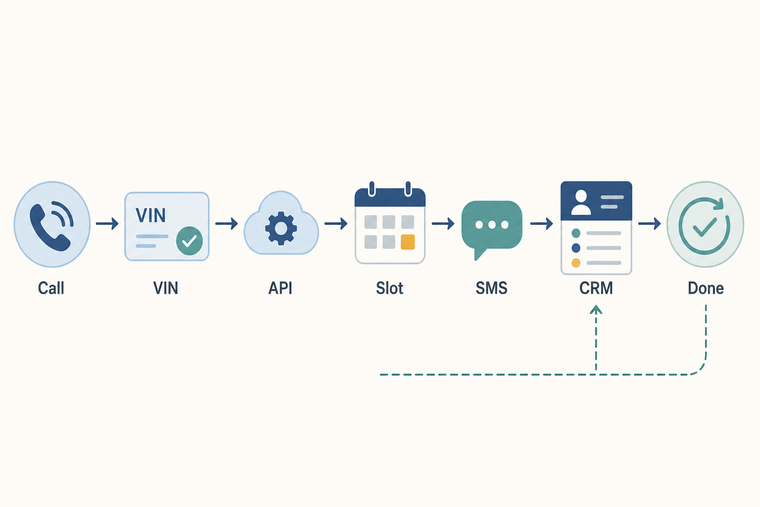
A practical flow looks like this:
- Identify the customer through phone number, license plate, or partial VIN.
- Check recall eligibility against manufacturer campaign data or a public recall API.
- Separate safety instructions such as “park outside,” “schedule service,” or “not affected.”
- Offer service slots by location, date, and time window.
- Write back to CRM and service systems with the call summary, intent, booking status, and handoff reason.
What the Human Advisor Must Receive
Voice AI does not need to complete every recall call. In automotive service operations, quality depends on deciding what can be automated and when the call must move to a person.
Required handoff fields
- customer_intent: recall_check | service_booking | safety_question | complaint
- vehicle_identifier: VIN / plate / phone-matched vehicle
- campaign_status: eligible | not_eligible | uncertain
- safety_instruction: park_outside | schedule_service | no_action | human_review
- appointment_status: proposed | confirmed | failed | advisor_followup
- handoff_reason: safety_unclear | customer_anxious | data_mismatch | exception
With this structure, the service advisor does not have to ask, “Why did you call?” The handoff feels continuous because the customer’s explanation moves with the call.
BringTalk POV: Recall Calls Are Safety Gates
For standard sales calls, LQA — Lead Qualification Automation — matters. For recall and service appointments, the more important layer is responsible safety routing.
- Context Injection loads the vehicle, campaign, and appointment context before the call starts.
- Zero Retention keeps identifiers such as VIN, phone number, and plate data from being stored on external LLM servers.
- Human Review Gate moves unclear safety questions or anxious customers to a person.
- Closed Loop sends booking, no-show, and completion status back to CRM and service systems.
In automotive service, the better operating metric is not “how many calls AI handled.” It is “how quickly and safely the system separated exceptions.”
Pre-Deployment Checklist
Before deploying this scenario, a service-center operator should define the operating boundary before tuning the model.
- Who owns recall campaign data freshness?
- How does the system recover from VIN or license-plate input errors?
- Who approves safety language and version changes?
- Are appointment slots checked in real time?
- What summary prevents repeated explanation after human handoff?
The core idea: automotive recall Voice AI is not a call-center replacement. It is a safety operating layer between recall data, appointment systems, and service advisors.