Voice AI Should Extend Frontline Teams, Not Replace Them
A frontline operating model for Voice AI, based on TELUS Digital and ElevenLabs partnership signals and CCW 2026 market coverage.


TELUS Digital and ElevenLabs announced a partnership on June 22, 2026 to scale Voice AI alongside frontline customer care teams. In the same week, CMSWire reported from CCW 2026 that AI agents are moving beyond pilot programs and into the operating structure of customer service.
Why The “Frontline Team” Framing Matters
Contact center automation is often discussed as a containment problem: how many calls can AI finish without a human? Enterprise operators need a sharper question. Which calls should AI finish, which calls should move to a person, and what evidence should follow the handoff into CRM?
That is why the TELUS Digital and ElevenLabs framing matters. Voice AI is being positioned next to frontline customer care teams, not as a disconnected bot channel. When AI is isolated, the customer experience fragments and agents cannot see what the AI heard, inferred, or decided.
The next competitive bar for Voice AI is not only “does it sound human?” It is “does it help the human team continue the work?”
After Pilots, The Bottleneck Is Routing
The signal from CCW 2026 coverage is that AI agents are entering the workforce layer. At that point, the bottleneck is not the model alone. The real operating bottleneck sits in three routing decisions.
- Is the customer intent simple service, exception handling, or a high-risk request?
- Does the call involve identity, payment, regulated information, or complaint risk?
- Will the human agent receive enough CRM evidence to continue without asking the customer to repeat everything?
If those decisions are not designed, AI may handle part of the call while lowering trust inside the care team. The moment an agent asks, “Why did the AI transfer this?” the operation has already lost time.
Good Voice AI Designs Handoff Quality
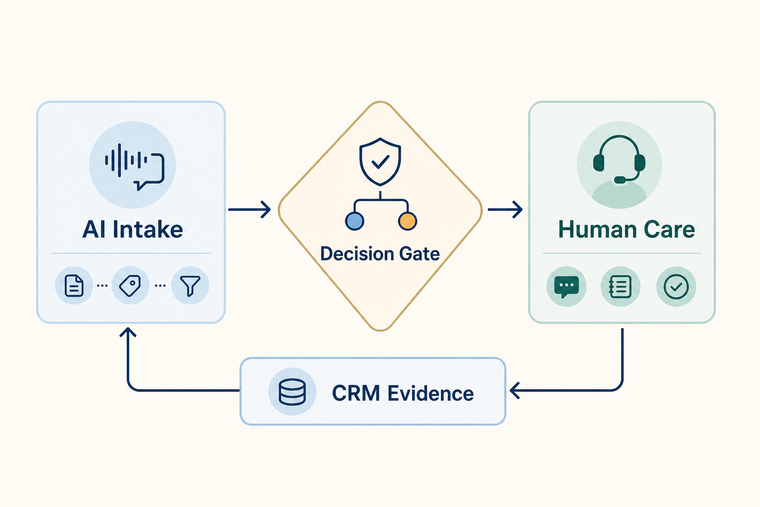
A frontline-ready Voice AI system should be designed as an operating loop.
AI Intake → Risk / Intent Gate → Human Care → CRM Evidence Loop
- AI Intake: Collect intent, urgency, account clues, and channel preference quickly.
- Risk / Intent Gate: Separate flows that require human confirmation, such as payment, complaints, healthcare, finance, or legal risk.
- Human Care: Give the agent a concise summary, original evidence, and recommended next action.
- CRM Evidence Loop: Feed outcomes back into routing rules, prompts, and quality standards.
The measurement target is not only AI-completed calls. It is also the quality of AI-transferred calls.
BringTalk POV: LQA And FUA Need A Human-Team Assumption
BringTalk’s LQA (Lead Qualification Automation) and FUA (Follow-Up Automation) should be designed as an operating layer for sales and customer teams, not as standalone voice bots. A high-intent lead should move to a human quickly. A simple appointment confirmation or callback request can be finished by AI.
The difference is not just voice quality. It is Context Injection and handoff criteria. Campaign source, previous touchpoints, and customer state should be injected into the call. After the call, the CRM record should preserve evidence a human can use.
Five Questions Operators Should Ask
- Are human-handoff conditions documented?
- Can agents see the AI summary and evidence in one place?
- Does the customer avoid repeating the same information?
- Are sensitive data, recordings, and summaries governed separately?
- Do failed handoffs become prompt and routing improvements?
The Adoption Unit Is The Team, Not The Bot
The 2026 Voice AI market signal is clear: contact centers are moving from AI-agent experiments to frontline operating models. Buying criteria should therefore move from “which model?” to “which operating decisions will this system make, record, and escalate?”
AI call completion and human handoff quality need to be designed in the same operating loop.