After ChatGPT Adoption Expands, Voice AI Needs a Governed Customer Front Door
As ChatGPT and workplace AI agents become normal tools, enterprise Voice AI should be designed as a governed customer front door with policy boundaries and evidence loops.


Public signals from OpenAI and Salesforce in late June and early July 2026 point in the same direction. AI is no longer a lab interface; it is becoming a normal work interface for employees and customers.
For enterprise customer operations, the question is no longer whether AI will be used. The question is which channel can be opened with enough control, context, and evidence.
The Recent Signal: Users Are Becoming Fluent in AI Interfaces
OpenAI’s RSS feed published “How ChatGPT adoption has expanded” on June 30, 2026, describing broader ChatGPT usage across regions, languages, and capabilities. In the same week, OpenAI also published “Mapping Europe’s AI Workforce Opportunity” on June 29 and “How agents are transforming work” on June 25.
Salesforce published “How Salesforce Is Closing the AI Skills Gap” on July 1, 2026, arguing that AI literacy needs to appear across school, career, and higher-education pathways. On June 29, Salesforce also published “Agents Run the Loop. Only Your Business Knows the Score,” framing agents as loops that still need business-defined goals.
These are vendor sources, so their claims should be read as market signals rather than neutral benchmarks. The operational implication is still useful: AI is moving from tool adoption into channel design.
Voice AI Is Not Just a Smarter Chatbot
Text AI expands internal productivity. Voice AI sits at the customer edge. A caller may share account status, appointment intent, consent, urgency, payment context, or sensitive information before a human ever enters the loop.
That makes Voice AI powerful, but also operationally exposed. The value is not simply a higher automation rate. The value is a governed front door that handles the first customer moment without losing policy control.
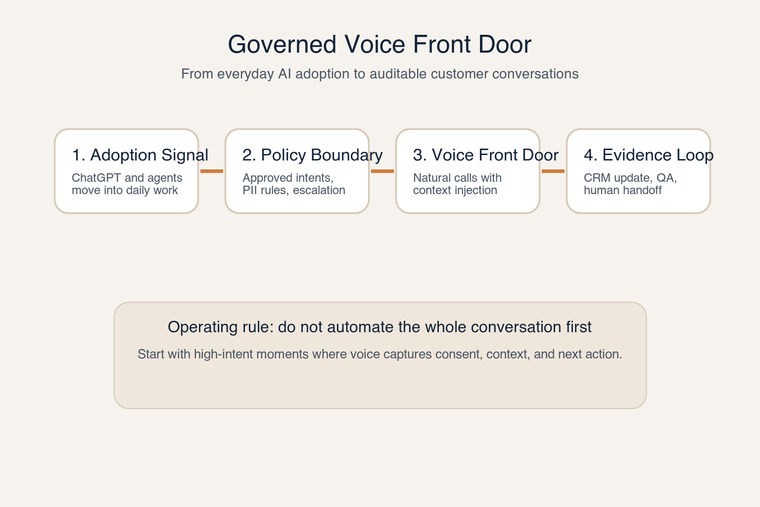
A Four-Step Operating Model
1. Adoption signal
   - Confirm where employees and customers already expect AI interaction
   - Find repeated high-intent moments, not generic FAQ volume

2. Policy boundary
   - Define allowed intents, blocked intents, PII handling, and disclosure
   - Separate Zero Retention, CRM writeback, and human handoff rules

3. Voice front door
   - Narrow the call goal before optimizing STT, LLM, and TTS
   - Use Context Injection, but do not let the model make unsupported decisions

4. Evidence loop
   - Record outcome, consent, next action, failure reason, and handoff context
   - Review failed and escalated calls weekly with operations and QA
The model is intentionally narrow. Instead of trying to replace every conversation, it starts with moments where evidence matters: appointment confirmation, lead qualification, follow-up consent, and human handoff.
Why “Customer Front Door” Changes the Buying Discussion
AI agent projects often start with model performance. In production, buyers ask a different set of questions. Did the customer know AI was involved? Was consent captured? Could the human agent pick up the context? Was sensitive data excluded from the wrong system?
A Voice AI design document should therefore answer five questions before it compares models.
- What is the maximum decision boundary for the AI in this call?
- When and how is AI usage disclosed to the customer?
- Which caller phrases trigger human handoff?
- What is written to CRM, and what is intentionally not stored?
- Which call samples does QA review every week?
BringTalk Application: Start With LQA and FUA
LQA, or Lead Qualification Automation, is a strong first lane. The call can confirm intent, timing, budget range, and the need for a human closer. It also creates useful context for the next agent or salesperson.
FUA, or Follow-Up Automation, is another practical lane. Missed inquiries, post-consultation callbacks, and appointment reminders are moments where customers already expect a next action. Voice AI can capture that action and update CRM without pretending to resolve everything alone.
The first lane should not be refund approval, contract cancellation, or sensitive dispute handling. Those workflows require human accountability. Voice AI should collect structured context and route the customer to the right person.
The Decision Checklist for This Week
If your team is reviewing Voice AI because broader AI adoption is accelerating, the first decision is not a model benchmark. It is the operating boundary.
- Three first intents: repetitive, high-intent, and valuable for handoff
- Three blocked intents: approval, cancellation, or sensitive judgment requiring a human
- One disclosure phrase: short, plain, and paired with human escalation
- Five or fewer CRM fields: outcome, next action, consent, handoff reason, failure reason
- One weekly review rhythm: failed calls and escalated calls reviewed together
As AI adoption expands, the Voice AI advantage is not sounding human. The advantage is making the customer front door governable.