The Voice AI WebRTC Session Contract: Turning Realtime APIs Into Operable Customer Channels
OpenAI Realtime API and Google Gemini Live API point to the same operating shift: Voice AI needs an explicit session contract across WebRTC, WebSocket, SIP, tools, and evidence.


Read the OpenAI Realtime API and Google Gemini Live API documentation side by side and the signal is clear: Voice AI advantage is no longer defined only by which model you call. It is increasingly defined by how a real-time session is opened, governed, recovered, and proven after the call.
WebRTC Is an Operating Boundary, Not a Demo Feature
MDN describes WebRTC as technology that lets applications capture and stream audio or video and exchange data without requiring plug-ins. OpenAI’s Realtime WebRTC documentation explains browser connection patterns using either ephemeral API keys or a unified interface. Google’s Gemini Live API documentation also points to real-time audio and video applications using WebRTC or WebSocket-based integrations.
The shift is not “the model can speak.” The shift is “the session can start safely, survive interruption, and remain explainable after it ends.”
From that perspective, a Voice AI project becomes a session product. Browser media, phone networks, SIP, WebSockets, tool calls, and audit logs need to be governed as one contract.
The 5 Fields Every Session Contract Needs
For enterprise Voice AI, a session contract is not a bundle of SDK options. It is the execution unit that product, security, and operations teams can review before go-live.
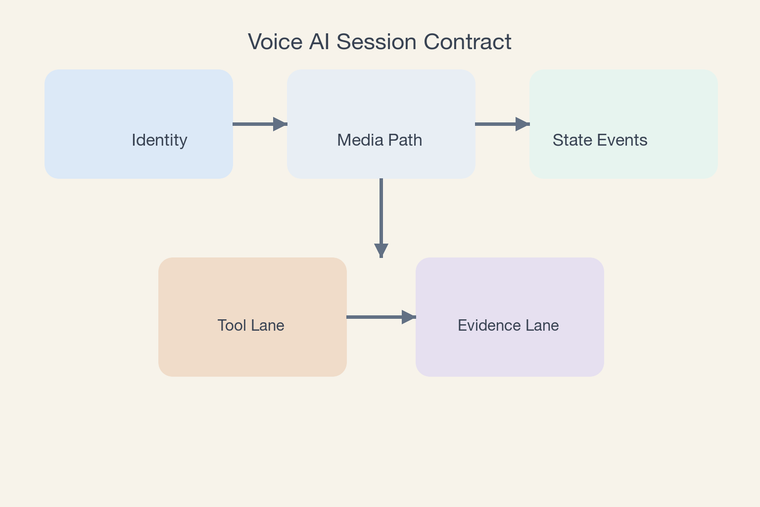
Voice AI session contract
1. Identity: caller/user/session id, consent state, tenant boundary
2. Media path: WebRTC, WebSocket, SIP, phone bridge, fallback route
3. State events: started, listening, interrupted, tool_waiting, escalated, ended
4. Tool lane: CRM lookup, booking, payment, ticket creation, policy guard
5. Evidence lane: transcript policy, event log, redaction, retention, audit export
If these fields are separated, the demo may still feel fast while production breaks. A WebRTC connection can succeed, but the customer experience fails if CRM state is lost during handoff or a tool timeout turns into silence.
Choosing a Realtime API Is Choosing a Network Pattern
OpenAI separates Realtime connection methods such as WebRTC, WebSocket, and SIP. Google’s Live API documentation separates raw WebSockets, session management, and ephemeral tokens. That distinction is not just developer ergonomics; it is the start of the operating model.
- Browser-based support and web demos naturally fit WebRTC because the user device owns microphone permission and media tracks.
- Server-mediated contact centers often need WebSocket or SIP bridging because recording, routing, and firewall policy sit server-side.
- Phone-network customer entry points must include phone numbers, SIP trunks, call queues, and human transfer behavior.
So “we connected the Realtime API” is not enough. The team needs to document which media path supports which customer entry point and where the session goes when that path fails.
Ephemeral Tokens Are Responsibility Boundaries
Realtime sessions use ephemeral tokens to avoid exposing long-lived credentials in the browser. In enterprise environments, that is only the first layer.
- Who minted the token?
- Which customer, tenant, and purpose does it cover?
- How quickly does it expire?
- What evidence remains after the session ends?
- Are tool permissions separated from media-session permission?
Without these answers, Voice AI remains a callable model. With these answers, security teams can understand the deployment boundary and operations teams can reproduce failure paths.
BringTalk POV: The Agent Gateway Enforces the Contract
BringTalk sees the Agent Gateway not as a simple proxy in front of a model, but as the control plane that enforces the session contract. Whether traffic enters through WebRTC, WebSocket, or SIP, the gateway should normalize customer state, tool permissions, interruption events, fallback policy, and audit evidence.
The Operator Checklist
- Is consent and tenant boundary resolved before the session starts?
- Are barge-in, silence, and tool timeout logged as separate events?
- Does human handoff include customer intent and the latest state?
- Are transcript retention and event-log retention separated?
- Does the session contract survive a model, STT, or TTS swap?
With this checklist, teams can change models without changing the operating standard. Without it, every model replacement reopens the same quality, security, and observability debate.
Bottom Line: Define the Session Before Calling the Model
In 2026, Voice AI teams should not evaluate only model names. The stronger go-live question is whether WebRTC connection handling, ephemeral tokens, session state, tool lanes, and evidence lanes live in one explicit contract.
The next Voice AI advantage is not just faster response. It is the governed session: speed, security, and customer experience moving through the same operating contract.
Sources: OpenAI Realtime API with WebRTC documentation; Google Gemini Live API documentation; MDN WebRTC API overview; Vapi documentation index for WebSocket transport, SIP integration, real-time call control, and call queue concepts.