Voice AI Now Needs an Agent Gateway Control Plane
The A2A Gateway pattern shows Voice AI moving from single-agent demos toward an operating layer for discovery, authorization, routing, and audit.


AWS’s July 1, 2026 A2A Gateway example is a useful signal for Voice AI teams. The next edge is no longer just “one good calling agent”; it is the control plane that discovers, routes, authorizes, and audits multiple agents during a customer conversation.
Why Agent Gateway, Why Now
Enterprises are already deploying many kinds of AI agents at once. A customer-service agent, CRM update agent, booking agent, payment-check agent, and internal approval agent may be built by different teams, vendors, and infrastructure stacks.
AWS frames the risk clearly: as point-to-point agent integrations grow, credentials, custom routing, and access control become fragmented. In voice channels, that fragmentation shows up faster. A customer expects identity check, intent capture, scheduling, and human escalation to feel like one conversation.
The bottleneck in Voice AI is not only the speaking model. It is the operating layer that decides which agent acts, when, and with what authority.
A2A Is the Protocol; the Gateway Is the Operating Model
Google’s 2025 Agent2Agent Protocol announcement defined A2A as an open protocol for agents to communicate, securely exchange information, and coordinate work. Its core ideas include Agent Card capability discovery, a task lifecycle, status updates, and artifacts.
But a protocol does not automatically solve operations. A live customer call still needs answers to practical questions: Which agent should handle this request? Is this agent allowed to read CRM data? Where is the state of a long-running task recorded?
AWS’s 2026 A2A Gateway pattern addresses that gap with a gateway layer. The A2A-native endpoints stay intact, while discovery, routing, and access control are centralized.
What a Voice Agent Gateway Must Do
A Voice AI gateway is not just a reverse proxy. A call combines latency, customer context, authorization, and human handoff in real time.
Customer call
  → Voice front door
  → Intent + identity context
  → Agent Gateway
      1. discover: find candidate specialist agents
      2. authorize: check customer, channel, and task permissions
      3. route: select booking, CRM, approval, or human handoff
      4. observe: record result, failure, and escalation reason
  → Backend agent or human team
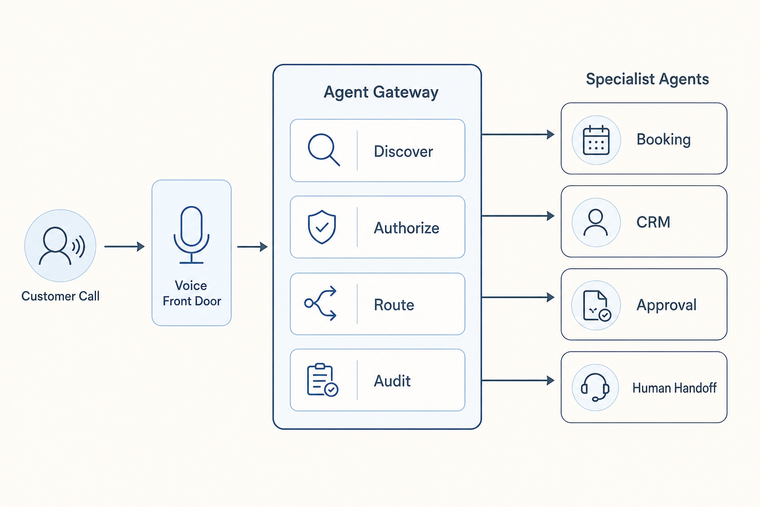
The key is not to merge every agent into one large prompt. Each agent should stay focused on its domain, while the gateway manages customer journey state and security boundaries.
BringTalk POV: Split the Front Door from Specialist Agents
As Voice AI projects grow, asking the first agent to do everything becomes risky. Intent classification, identity check, appointment booking, sales qualification, claim intake, and advisor handoff all pile into one prompt. Testing becomes harder, and authorization boundaries become vague.
A safer BringTalk operating model separates the Voice Front Door from Specialist Agents.
- Voice Front Door receives the caller’s words, intent, urgency, and channel context.
- Agent Gateway decides which specialist should act and verifies permissions.
- Specialist Agent performs a narrow task such as booking, CRM update, or approval request.
- Human Handoff catches failures, exceptions, and high-risk requests with a recorded reason.
This also makes LQA and FUA cleaner. Lead qualification can be handled by a specialist that writes scores and evidence, while follow-up automation can inherit state and continue the journey.
Start with Four Operating Gates
A team does not need a large platform on day one. The practical starting point is four gates.
- Capability Gate: define what each agent can handle, what input it expects, and when it must fail.
- Authorization Gate: separate read and write access by customer type, channel, and task sensitivity.
- Routing Gate: choose a specialist agent or human handoff based on intent and confidence.
- Audit Gate: record which agent acted, why it acted, and what artifact it produced.
The audit gate matters especially in voice. Calls pass in real time, and customers later ask what was promised. A transcript is not enough; the system needs task-level and artifact-level evidence.
What Not to Overclaim
A2A and gateways do not solve every Voice AI problem. Production quality still depends on STT accuracy, latency budget, prompt policy, CRM data hygiene, and fallback design.
What the A2A trend does show is a direction: enterprise Voice AI is moving from single-agent demos to multi-agent operating systems.
The 2026 question is shifting from “which model do we use?” to “how do we discover, authorize, route, and audit agents inside a live customer conversation?”