Voice AI Cost Control Now Needs Model Right-Sizing by Call State
Salesforce’s inference-spend right-sizing shows why Voice AI should route each call state to the right model, rule, or human-approval path.

The next constraint in enterprise AI budgets is not whether the model is smart enough. It is whether every task is being sent to the same size of model. On July 8, 2026, Salesforce explained how it manages inference spend by right-sizing models for the job. Voice AI needs the same discipline: not every turn in a live call deserves a frontier model.
Model Assignment Matters More Than Model Size
Salesforce’s core point is simple: most enterprise work needs the right intelligence for each job, not the most intelligence for every job. In Voice AI, that distinction becomes operational. One phone call contains greetings, consent, identity checks, intent classification, appointment handling, policy interpretation, complaint escalation, summarization, and CRM updates.
Voice AI cost control is less about finding the cheapest model and more about deciding which call state deserves which level of intelligence.
A greeting or status check can often use a script, cache, rule, or compact model. Refund exceptions, contract terms, complaints, and regulated disclosures need stronger reasoning and sometimes human approval. If the entire call is routed through one model class, cost, latency, and accountability become tightly coupled in the wrong way.
Voice AI Right-Sizing Should Start With Call State
Chat interfaces can survive some delay. Voice AI cannot. The model-routing decision has to ask not only “Is this task hard?” but also “How quickly does this answer need to arrive while the customer is waiting?”
Call state              Recommended intelligence layer
------------------------------------------------------
Greeting / consent      Script, policy template, small model
Intent classification   Fast classifier + confidence threshold
FAQ / appointment       Retrieval + compact model
Pricing / contract      Stronger model + policy guardrail
Complaint / risk        Escalation gate + human handoff
After-call summary      Batch model + CRM schema validation
The key is to separate real-time call decisions from asynchronous after-call work. The live conversation should use narrow, fast decisions wherever possible. Summaries, CRM updates, quality review, and exception analysis can use slower but more careful paths after the call.
The First Risk Is Failure Cost, Not Model Cost
Right-sizing becomes dangerous when it is treated only as cost reduction. A smaller model in the wrong lane can create wrong answers, repeated questions, missing disclosures, or delayed handoff. The business cost of those failures can exceed the inference bill.
Teams should define three lanes before tuning model spend:
- Low-risk lane: scripts, FAQs, appointment lookup, and other flows a small model or rules can safely handle
- Judgment lane: situations that need customer context, policy interpretation, and a stronger model
- Stop lane: sensitive data, contract changes, claims, disputes, or anything that needs human approval
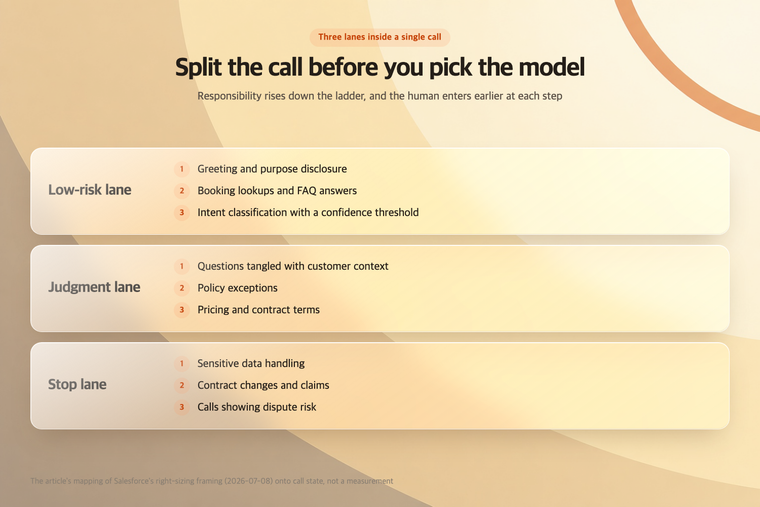
Responsibility rises down the ladder, and the human enters earlier at each step. The article's mapping of Salesforce's right-sizing framing onto call state, not a measurement.
Salesforce’s June 25, 2026 Agentforce Help Agent announcement also emphasized reducing the burden of connecting knowledge, defining actions, and wiring channels. The same is true for Voice AI. This is not just model selection. It is the design of knowledge, actions, approval paths, and channel surfaces around each call state.
Slack and CRM Become the Exit Surface for Model Routing
On July 8, 2026, Salesforce also described Slackbot gaining access to Salesforce data, Tableau, Data 360, and AI agents so teams can look up information and take action where work happens. For Voice AI, that direction matters because the call should not end as a transcript alone.
The final step of model right-sizing is sending the output to the work system:
- Sales lead: CRM stage, next action, owner alert
- Customer support: ticket priority, escalation reason, SLA clock
- Appointment or recall: eligibility, slot hold, advisor handoff
- Sensitive case: human approval queue, audit note, disclosure evidence
Small models keep the call moving. Larger models handle high-value judgment. Slack and CRM give humans a visible surface for review and action.
BringTalk POV: An AI Call Team Is a Routing Policy
BringTalk’s AI call team should not mean sending every call into one giant model. Customer journey data should be injected only when needed through Context Injection. Sensitive data should follow Zero Retention boundaries. When the decision risk increases, the system should move into approval or handoff rather than pretending every turn is equally safe.
This also changes how LQA and FUA should be designed. LQA is not one scoring prompt at the end of a call. It is a classification system that connects call state, customer context, and the next action. FUA is not only a follow-up message generator. It is the loop that turns call evidence into CRM-ready work that a human can review.
The goal of model right-sizing is not “the cheapest AI.” It is fast where the customer is waiting, careful where responsibility is high, and evidence-rich where humans need to act.
Adoption Checklist
If your team is already piloting Voice AI, start with these questions:
- Are model, rule, and human-handoff policies separated by call state?
- Do compact-model lanes have confidence thresholds and fallback wording?
- Are sensitive decisions routed into approval queues instead of being fully automated during the call?
- Is after-call summarization validated against the CRM schema?
- Do Slack or CRM alerts create next actions, not just transcript links?
If those answers are unclear, changing models will not stabilize cost or quality. The next optimization in Voice AI is not a model spreadsheet. It is an operating policy that connects call states, model tiers, and the systems where work actually happens.
Sources
- Salesforce, “How We Cut Inference Spend by Right-Sizing Our Models,” 2026-07-08: https://www.salesforce.com/news/stories/cutting-inference-spend-by-right-sizing-models/
- Salesforce, “Slackbot Can Now Do Anything Salesforce Can. Just Ask,” 2026-07-08: https://www.salesforce.com/news/linked-content/slackbot-can-now-do-anything-salesforce-can-just-ask/
- Salesforce, “Salesforce Launches Agentforce Help Agent That Deploys in Minutes and Only Charges for Resolutions,” 2026-06-25: https://www.salesforce.com/news/stories/agentforce-help-agent-announcement/