GPT-Live: Voice AI Is Moving Toward Real-Time Conversation Agents
OpenAI’s GPT-Live shows that Voice AI competition is moving from voice interfaces to full-duplex real-time conversation systems.


OpenAI’s GPT-Live, announced on July 8, 2026, is the new engine behind ChatGPT Voice. The important part is not simply that the voice sounds more natural. The larger shift is that Voice AI is moving from a turn-based voice interface toward a full-duplex real-time conversation system.
The new Voice AI benchmark is no longer “Can the AI speak?” It is “Can it decide when to listen, when to speak, and when to stop?”
Why Earlier Voice AI Felt Awkward
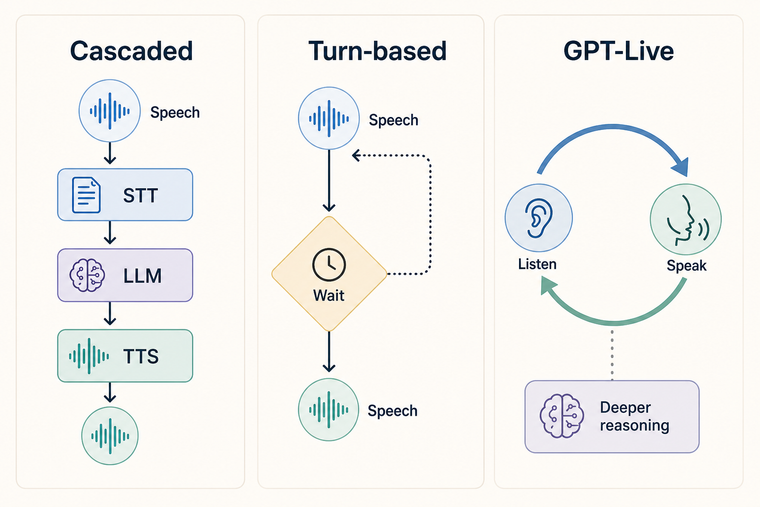
Early voice AI systems were usually cascaded. They converted speech into text, sent the text to a language model, and then converted the generated answer back into speech.
Speech → STT → LLM → TTS → Speech
This architecture is easy to build, but it loses important conversational signals. Tone, hesitation, emotion, pace, and interruption cues can disappear when speech is flattened into text. It also creates latency, because STT, LLM, and TTS have to run in sequence.
Later audio-native systems, including Advanced Voice Mode, reduced this latency by processing audio more directly. But many systems still followed a turn-based rhythm: wait until the user stops speaking, then respond. That model breaks down when the user pauses to think, background noise interrupts the signal, or both parties speak over each other.
GPT-Live’s Core Change: Full-Duplex Conversation
GPT-Live is designed around full-duplex interaction: listening and speaking at the same time. Human conversation works this way. We listen while the other person speaks, give short backchannels, pause when interrupted, and resume when the other person is ready.
GPT-Live attempts to handle this at the model level. It continuously receives input while generating output and repeatedly decides what to do next.
Should I listen now?
Should I speak now?
Should I pause?
Did the user interrupt?
Do I need a tool or search?
Should deeper reasoning be delegated to another model?
This is more than a UX improvement. In sales, support, education, healthcare scheduling, and customer service, timing is part of trust. A good voice agent is not just an agent that speaks well. It is an agent that does not break the rhythm of the conversation.
Continuous Interaction: Processing Flow, Not Messages
Text chatbots usually process discrete messages. The user sends a message, the model answers, and the next turn begins. Voice conversation is not that clean. Users pause, restart, interrupt, hesitate, and ask the system to wait.
The first major change in GPT-Live is that it treats conversation as a continuous stream. Instead of only asking whether the user has finished speaking, the model tracks the conversational state in real time.
That matters because real calls include silence, noise, overlapping speech, and emotional changes. A voice demo can look strong in a quiet environment and still fail in production. The production test is whether the agent preserves conversational rhythm under real conditions.
Delegation: GPT-Live Handles the Conversation, a Background Model Handles Deeper Work
OpenAI also describes a delegation structure. GPT-Live manages the real-time conversational layer. When the task requires search, complex reasoning, or agentic work, it delegates that work to a stronger background model. At launch, OpenAI describes GPT-5.5 as the model used for that deeper work.
The architecture can be summarized like this:
User ↔ GPT-Live: listening, speaking, interruption, turn-taking
GPT-Live ↔ Frontier model: search, reasoning, agentic tasks
This separation is important. GPT-Live owns the front-stage conversation, while heavier reasoning happens in the background. The user can continue interacting while deeper work is underway. It also means the conversational layer can remain stable while the backend “brain” improves over time.
Evaluation Is Moving Toward Conversation Quality
OpenAI says GPT-Live-1 and GPT-Live-1 mini outperform Advanced Voice Mode in human preference tests, especially around turn-taking, interruption handling, and naturalness.
The announcement also mentions three benchmark areas:
- GPQA for scientific reasoning
- BrowseComp for agentic web search
- τ³-Voice Telecom for multi-turn telecom support scenarios
Public summaries did not provide exact percentages or scores, so this article does not claim specific benchmark numbers. The important signal is the evaluation direction. Voice AI performance is no longer only about speech quality or answer accuracy. It also includes timing, interruption handling, search and reasoning delegation, and the ability to complete multi-turn support scenarios.
What Changes in ChatGPT Voice
GPT-Live brings four notable user experience changes to ChatGPT Voice.
-
More natural conversation
The system can pause when interrupted, wait when the user needs time, and use short backchannels such as “mm-hmm” or “yes” to keep the conversation alive. -
Smarter answers
Users can choose reasoning intensity such as Instant, Medium, and High, balancing response speed against deeper thinking. -
Better listening
The system is designed to avoid treating every short silence as the end of a turn and to focus on the speaker’s voice in noisy environments. -
Visual answers
For information such as weather, stocks, and sports, the system can show visual cards during voice conversations.
Together, these changes suggest that Voice AI is becoming a multimodal work interface rather than a voice-only channel.
Safety Is an Operating Requirement
The safety section of the announcement is also important. OpenAI describes audio-native safety evaluation for risks such as self-harm, psychosis or mania, emotional reliance on AI, violence, sexual content, and youth safety.
Real-time safeguards are part of the design. If risk signals appear, the system can steer the model toward safer responses, show additional safety messages, or end the conversation in high-risk cases. For self-harm conversations, it can support crisis-resource routing. The announcement also mentions parental controls and protections against mimicking real people’s voices.
Voice AI feels more emotionally close than text AI. It uses sound, timing, and response rhythm. That means safety cannot be treated as an add-on after launch. It has to be part of the operating model.
Rollout and Current Limits
GPT-Live is rolling out globally across iOS, Android, and ChatGPT.com. Go, Plus, and Pro users get GPT-Live-1 by default, while Free users get GPT-Live-1 mini. API access is planned for later.
There are also limits. Some languages may still show accent or fluency gaps. Voice conversations with video or screen sharing are not supported at launch. Standard Voice Mode and Advanced Voice Mode remain available.
BringTalk Perspective: The Model Is Not the Whole Product
GPT-Live raises the baseline for the entire Voice AI market. Customers will increasingly expect lower latency, better interruption handling, stronger listening, and deeper answers as defaults.
But enterprise deployment is not solved by the model alone. Buyers do not only want an AI that sounds natural. They want an AI that completes real work.
Real-time voice model
+ industry-specific conversation design
+ CRM, booking, payment, and support integrations
+ failure monitoring
+ human handoff
+ consent, security, and audit trails
As models improve, demo-level voice agents will become easier to copy. The harder and more valuable layer is the operating system around the model: workflow design, integrations, evaluation, monitoring, and governance.
For BringTalk, the implication is clear. The job is not just to choose the best voice model. The job is to turn that model into a production customer-contact system that produces measurable business outcomes.
Conclusion
GPT-Live is not just a ChatGPT Voice update. It is a sign that Voice AI is moving from “talking chatbot” to “real-time conversation agent.”
The next competition will not be decided only by voice naturalness. It will be decided by timing, interruption handling, background reasoning, safety controls, and operational integration.
After GPT-Live, the central question is not whether the AI sounds human.
The question is whether it can complete real work inside a live customer conversation.
Source: OpenAI, “Introducing GPT-Live,” announced July 8, 2026.