Retail Returns Voice AI Needs an Exception-Resolution Loop
Returns calls are not simple FAQs. They change order, policy, delivery, and refund state. Here is how retail Voice AI should separate safe automation from human approval gates.


Returns are one of the most expensive customer touchpoints in ecommerce. NRF and Happy Returns’ 2024 report projected U.S. retail returns to reach $890 billion in 2024, and found that 76% of consumers consider free returns a key factor when deciding where to shop.
But when a customer calls, the problem is rarely “Can I return this?” in isolation. The order exists, the delivery status has changed, the packaging may be damaged, and the customer may now prefer an exchange over a refund. Voice AI should therefore be designed as an exception-resolution loop, not as a returns FAQ.
Returns Calls Are State Transitions, Not FAQs
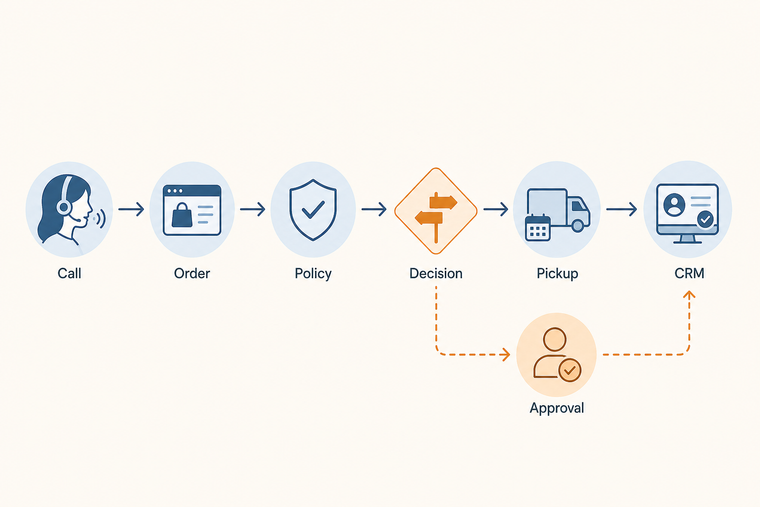
A returns conversation looks repetitive from the outside, but operationally it changes state across several systems: order lookup, policy validation, inventory, pickup scheduling, payment reversal, loyalty credits, and CRM notes.
The goal of returns Voice AI is not to end the call quickly. It is to decide the next state accurately and leave evidence behind.
NRF’s $890 billion projection means returns are no longer a back-office cost line. They are part of customer retention, conversion, and post-purchase trust. If returns stay inside IVR menus or thin chatbot answers, customers will keep asking for a human because the system cannot resolve the actual exception.
The Five-Step Exception Loop
Voice AI should not stop at identifying the reason for return. It needs to move the customer request into the next operational state.
1. Identify        Customer, order, product, and delivery state
2. Interpret       Return reason mapped against policy conditions
3. Decide          Refund, exchange, pickup, or store-return path
4. Gate            Fraud, high-value, or policy exceptions to human approval
5. Evidence        Decision rationale stored in CRM, OMS, or CS ticket
With this loop, human agents spend less time repeating order lookup and more time approving edge cases. AI handles state transitions inside clear policy boundaries. Humans handle judgment outside those boundaries.
Free Returns Raise the CX Bar
The NRF and Happy Returns report says 76% of consumers consider free returns important when choosing where to shop. That makes returns policy part of the buying decision, not just the post-purchase experience.
Yet free returns alone do not solve the service problem. Customers want immediate answers to questions such as:
- Is this order eligible for return?
- Is refund or exchange faster?
- Can pickup be scheduled?
- What happens if the package is opened or damaged?
- When will card reversal or replacement shipment be reflected?
Zendesk’s CX Trends 2026 page highlights repeat storytelling as a major source of frustration, noting that 74% of customers find it frustrating to repeat their story to different agents. A returns Voice AI that does not remember prior explanations or order state simply adds another repetition layer.
Human Gates Are an Operating Design, Not a Failure
The riskiest returns automation design assumes AI should complete every decision end to end. High-value goods, repeat returns, mismatched payment methods, delivery disputes, and edge cases near policy boundaries should move to a human approval gate.
Cases AI Can Close
- Unopened items inside the policy window
- Color or size exchange for the same SKU family
- Pre-approved pickup-slot scheduling
- Basic refund-timing explanation
Cases Humans Should Approve
- High-value items, loss, or fraud signals
- Exceptions after the policy window
- Payment reversal failures or duplicate-refund risk
- Complaints that may escalate into compensation or legal dispute
Without this boundary, AI either escalates too conservatively or approves refunds it should not approve. Operations teams should define the boundary of safe automation before they chase automation rate.
BringTalk POV: A Returns Call Is a Revenue-Recovery Loop
BringTalk does not treat the returns call only as a cost-reduction target. A customer requesting a return can still become an exchange, repurchase, retention, or membership-save opportunity.
That requires three operating layers:
- Context Injection — order, delivery, customer tier, and prior conversation context before the call starts.
- Decision Gate — clear separation among refund, exchange, compensation, and human approval policies.
- Evidence Update — AI decisions and customer statements written back to CRM or OMS so the next interaction does not restart from zero.
In this model, “Every call becomes revenue” is not just a tagline. A well-handled returns call can reduce frustration and route the customer back toward exchange or repurchase.
Implementation Checklist
Before launching retail returns Voice AI, confirm these five items:
- Is the returns policy represented as machine-readable conditions?
- Which systems will AI read from and write to: OMS, WMS, payments, CRM?
- What amount, product, and time-window thresholds can AI approve automatically?
- What evidence must transfer to the human agent at the approval gate?
- Where will prior customer statements and decision rationale be stored to avoid repetition?
Returns Voice AI succeeds when it separates “automate inside policy” from “escalate outside policy” cleanly — not when it simply answers faster.